Overview
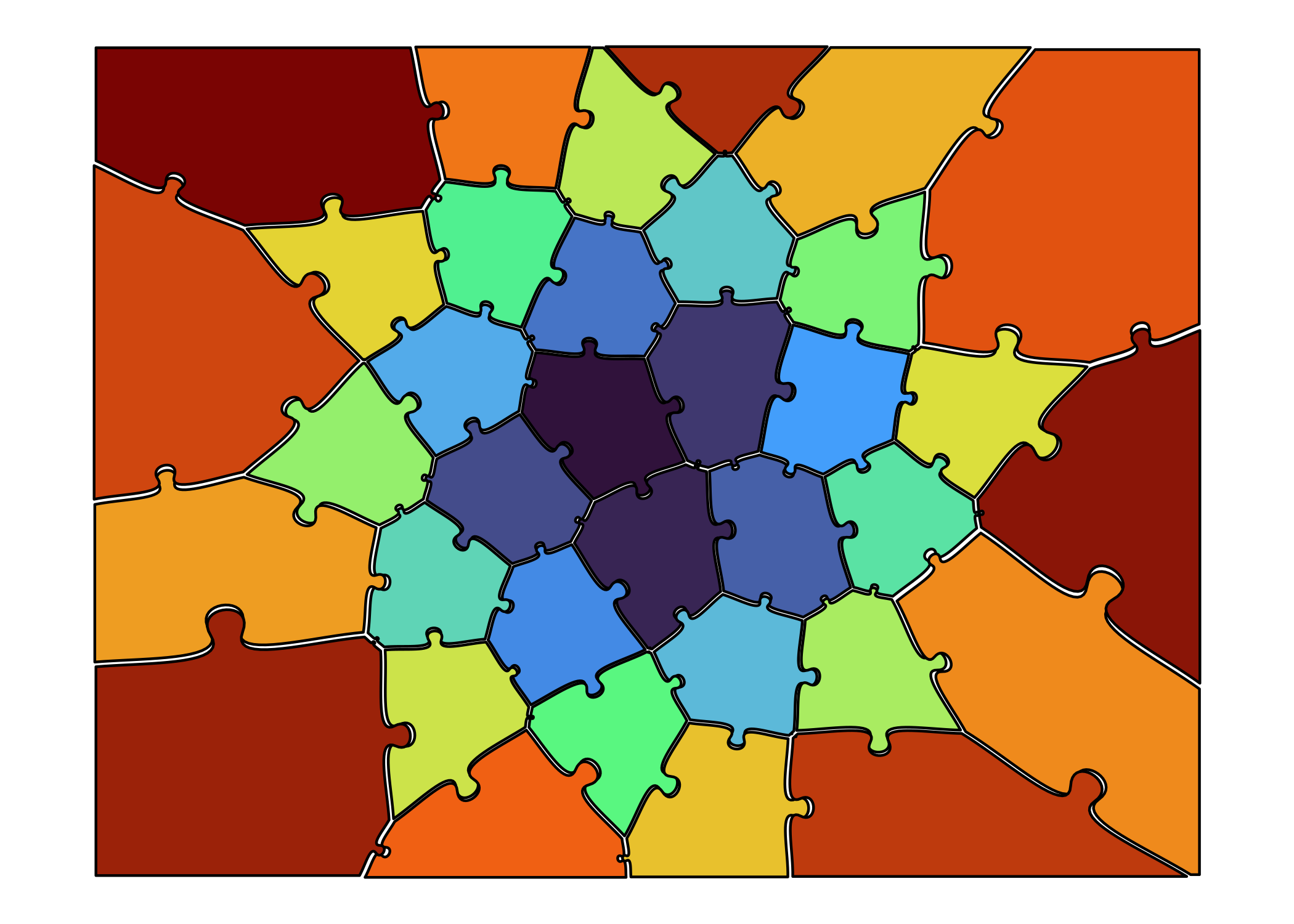
Voronoi puzzles create organic, natural-looking pieces based on Voronoi tessellation. Each piece is a convex polygon formed by the regions closest to a set of seed points. The result resembles patterns found in nature, like honeycomb cells, giraffe spots, or cracked mud.
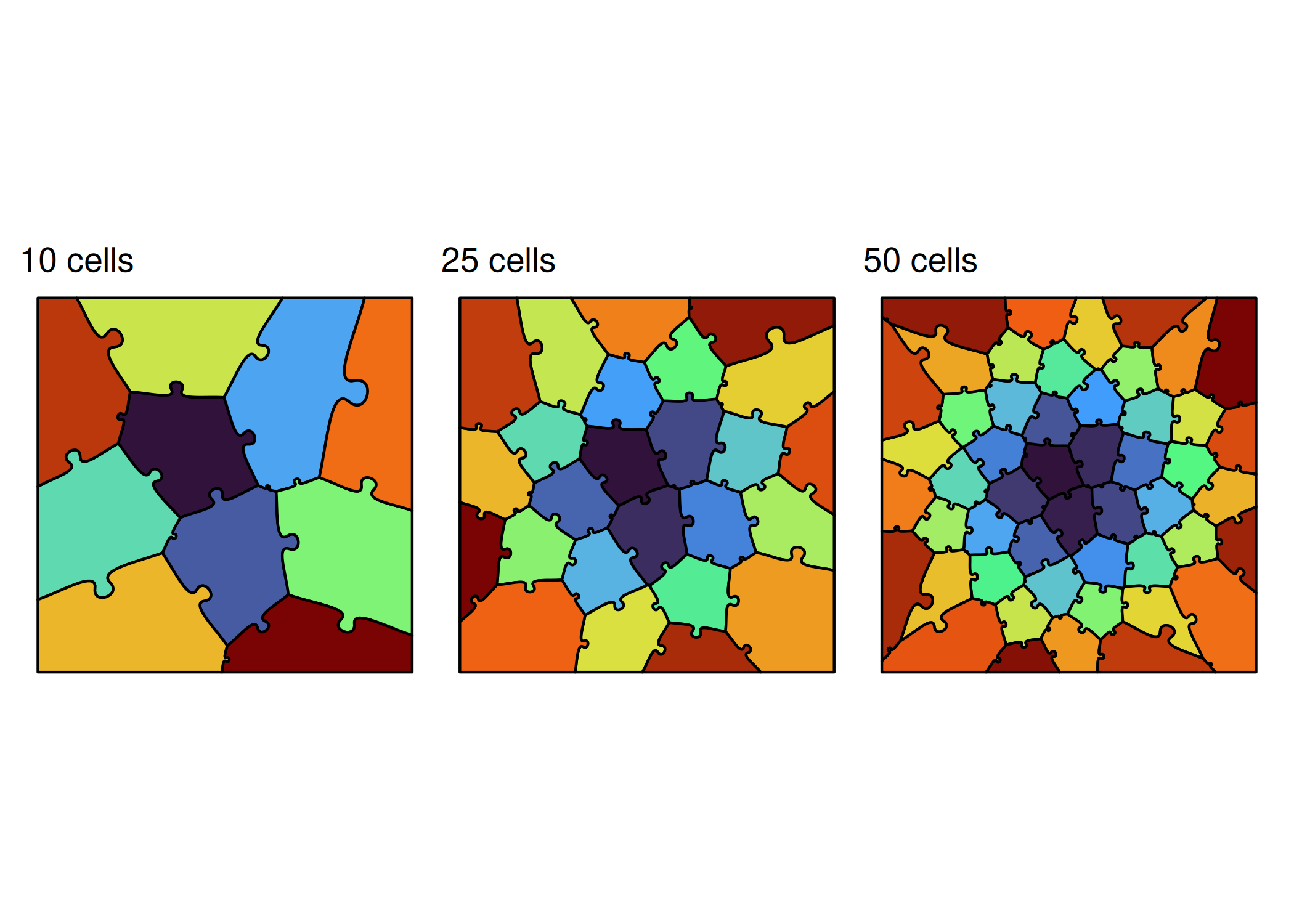
Cell Count Variations
<- function (n) {ggplot () + geom_puzzle_voronoi (aes (fill = after_stat (piece_id)),n_cells = n,seed = 42 + scale_fill_viridis_c (option = "turbo" , guide = "none" ) + coord_fixed () + theme_puzzle () + labs (title = paste0 (n, " cells" ))print (make_vor_cells (10 ) + make_vor_cells (25 ) + make_vor_cells (50 ))
# Generate cell count previews in a grid <- c (10 , 25 , 50 )<- lapply (cells, function (n) {generate_puzzle (type = "voronoi" , grid = c (n), size = c (200 , 200 ), seed = 42 , fill_palette = "turbo" )render_puzzle_grid (items, ncol = 3 , labels = paste (cells, "cells" ))
Voronoi puzzles adapt to any aspect ratio - wide, square, or tall. See the Aspect Ratios Tutorial for examples comparing all puzzle types.
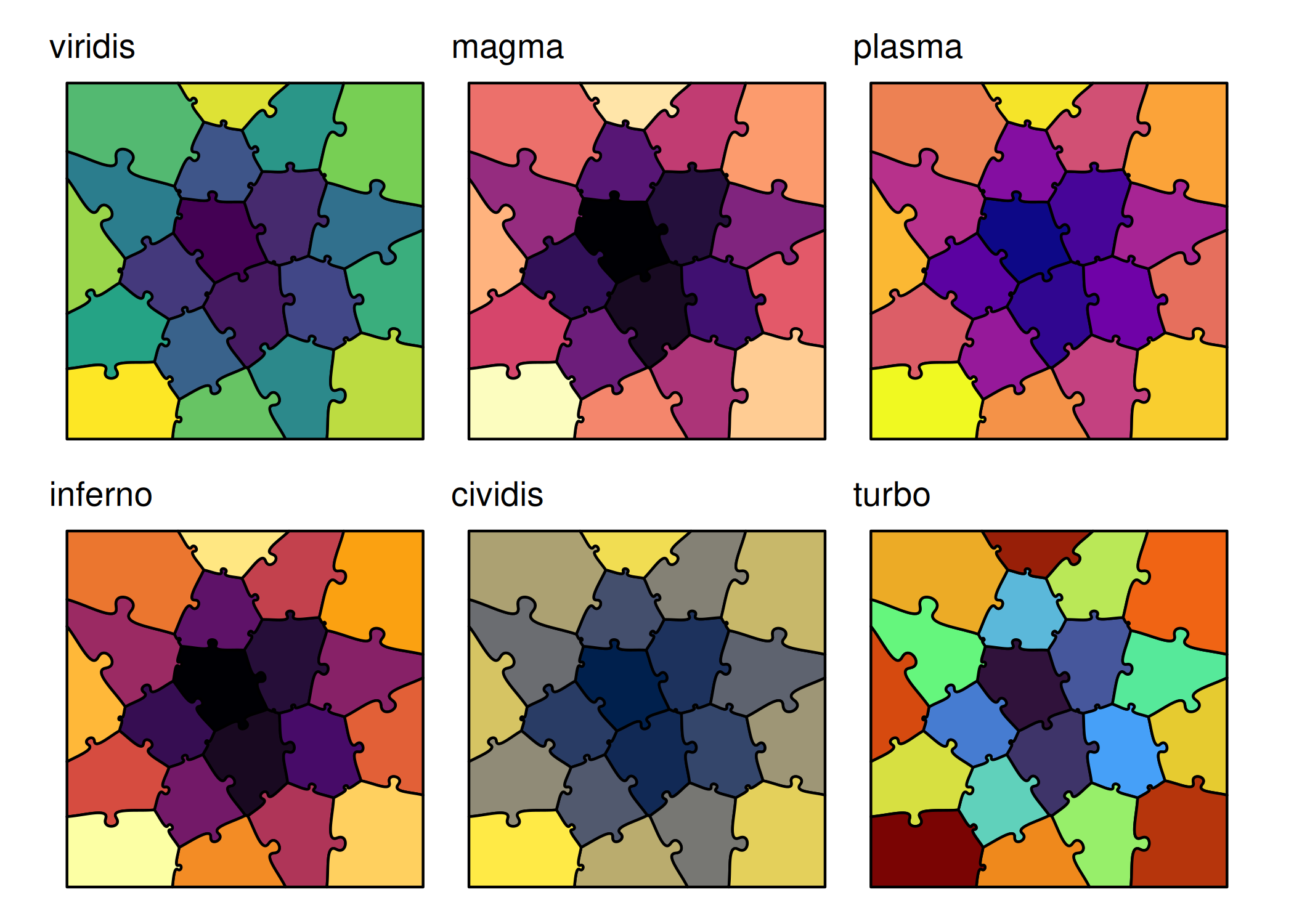
Color Palettes
<- function (pal) {ggplot () + geom_puzzle_voronoi (aes (fill = after_stat (piece_id)),n_cells = 20 ,seed = 42 + scale_fill_viridis_c (option = pal, guide = "none" ) + coord_fixed () + theme_puzzle () + labs (title = pal)print ((make_vor_palette ("viridis" ) + make_vor_palette ("magma" ) + make_vor_palette ("plasma" )) / make_vor_palette ("inferno" ) + make_vor_palette ("cividis" ) + make_vor_palette ("turbo" )))
# Generate all palette previews and combine into a grid <- c ("viridis" , "magma" , "plasma" , "inferno" , "cividis" , "turbo" )<- lapply (palettes, function (pal) {generate_puzzle (type = "voronoi" , grid = c (20 ), size = c (200 , 200 ), seed = 42 , fill_palette = pal)render_puzzle_grid (items, ncol = 3 , labels = palettes)
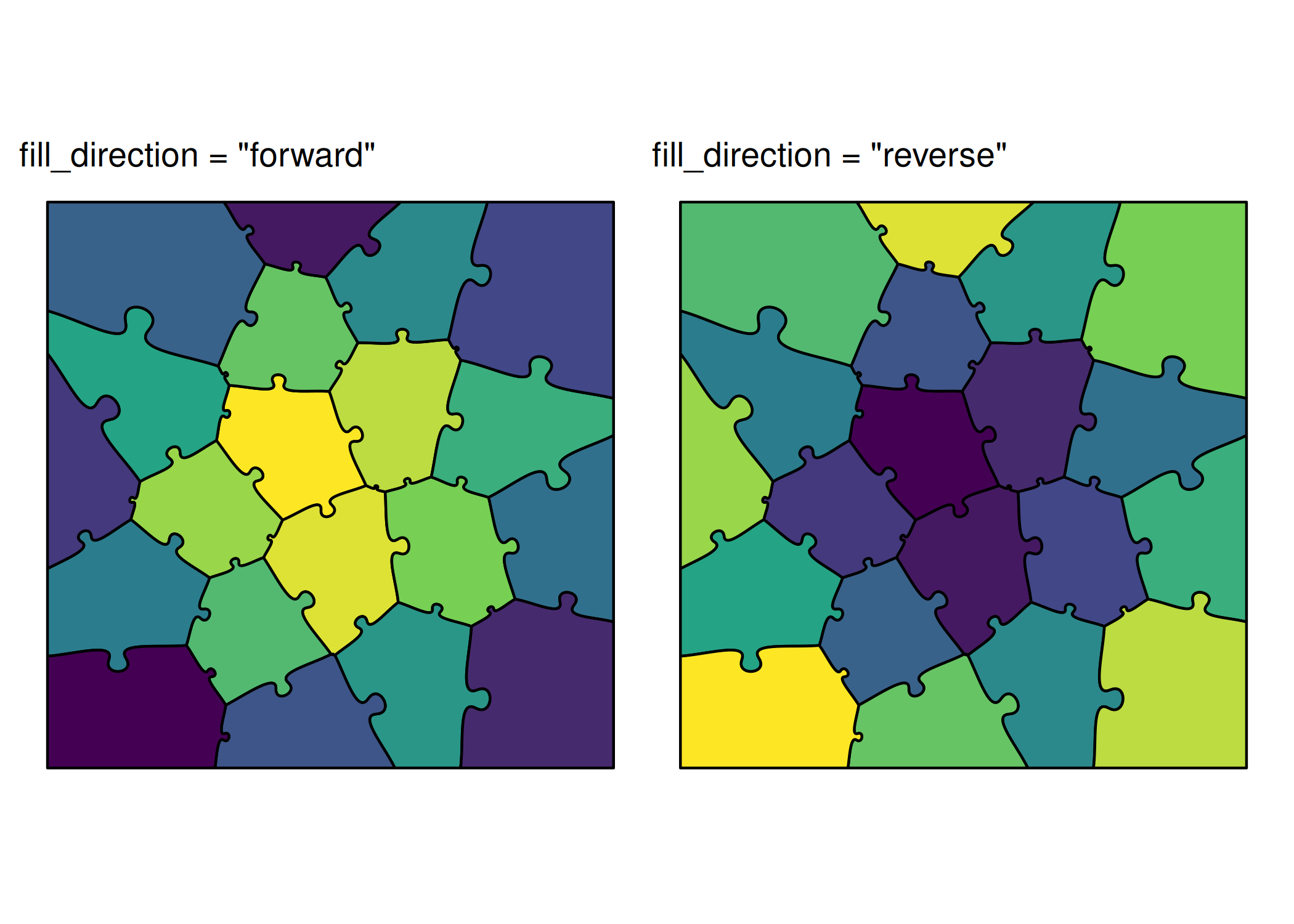
Fill Direction
Control the spatial order of color assignment. This is distinct from palette_invert which reverses the dark↔︎light ends of the palette.
<- function (dir) {ggplot () + geom_puzzle_voronoi (aes (fill = after_stat (fill_order)),n_cells = 20 ,fill_direction = dir,seed = 42 + scale_fill_viridis_c (option = "viridis" , guide = "none" ) + coord_fixed () + theme_puzzle () + labs (title = paste0 ("fill_direction = \" " , dir, " \" " ))print (make_direction_plot ("forward" ) + make_direction_plot ("reverse" ))
<- c ("forward" , "reverse" )<- lapply (directions, function (dir) {generate_puzzle (type = "voronoi" , grid = c (20 ), size = c (200 , 200 ), seed = 42 , fill_palette = "viridis" , fill_direction = dir)render_puzzle_grid (items, ncol = 2 , labels = paste0 ("fill_direction = \" " , directions, " \" " ))
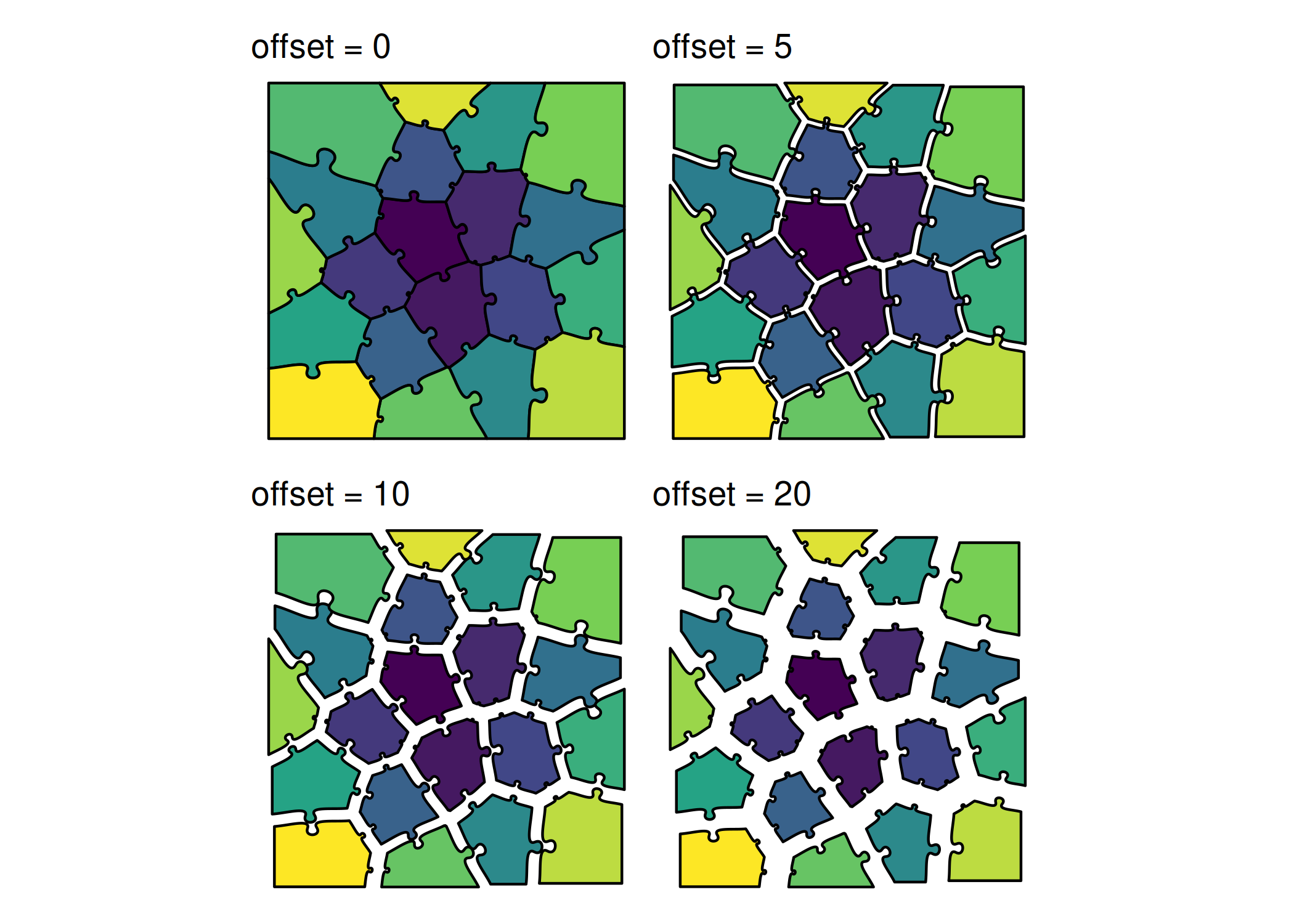
Offset (Separation)
<- function (off) {ggplot () + geom_puzzle_voronoi (aes (fill = after_stat (piece_id)),n_cells = 20 ,offset = off, seed = 42 + scale_fill_viridis_c (option = "viridis" , guide = "none" ) + coord_fixed () + theme_puzzle () + labs (title = paste0 ("offset = " , off))print (make_vor_offset (0 ) + make_vor_offset (5 ) + make_vor_offset (10 ) + make_vor_offset (20 ))
# Generate offset previews in a grid <- c (0 , 5 , 10 , 20 )<- lapply (offsets, function (off) {generate_puzzle (type = "voronoi" , grid = c (20 ), size = c (200 , 200 ), seed = 42 , offset = off, fill_palette = "viridis" )render_puzzle_grid (items, ncol = 4 , labels = paste ("offset =" , offsets))
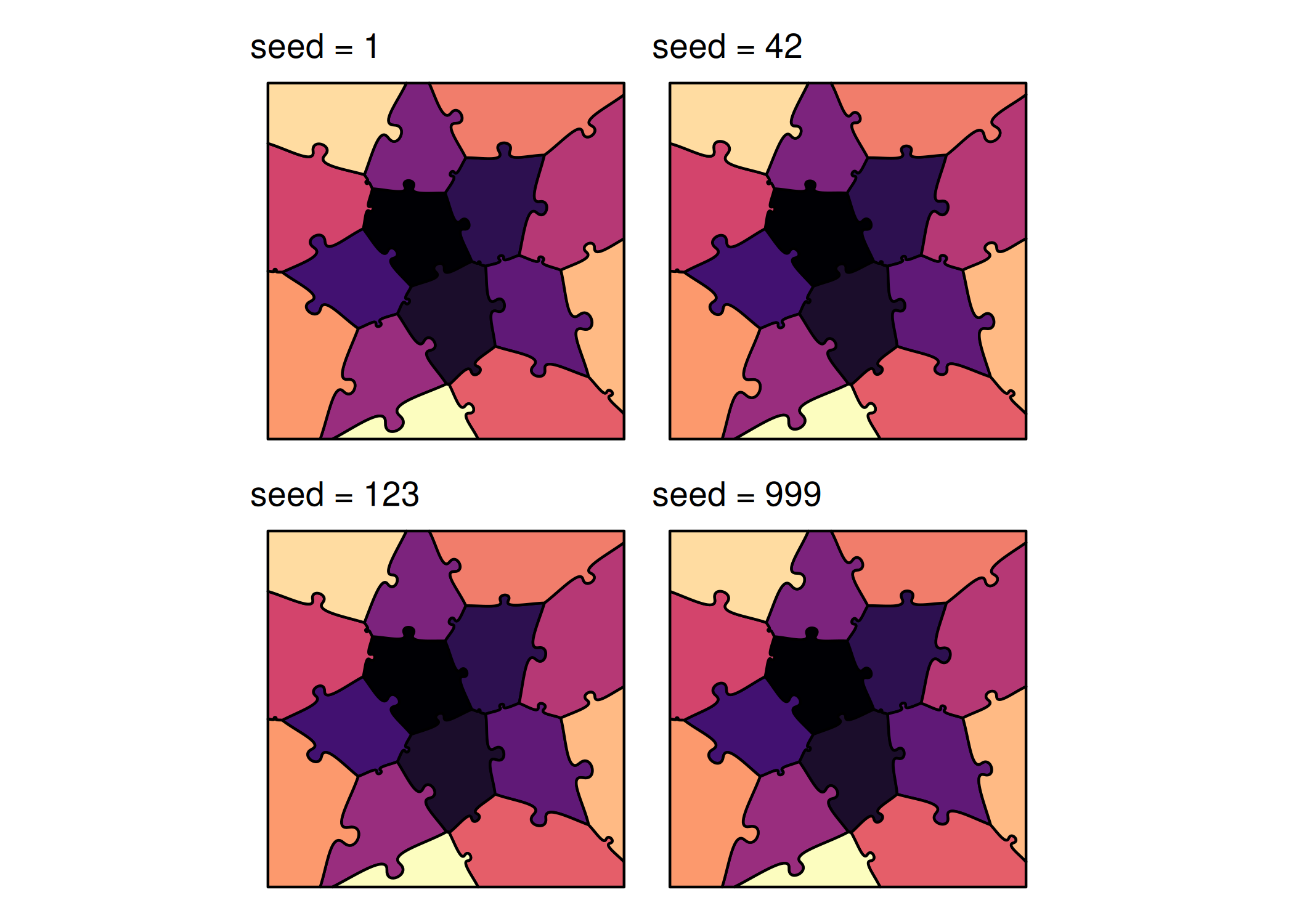
Seed Variations
Different seeds create completely different tessellations:
<- function (s) {ggplot () + geom_puzzle_voronoi (aes (fill = after_stat (piece_id)),n_cells = 15 ,seed = s+ scale_fill_viridis_c (option = "magma" , guide = "none" ) + coord_fixed () + theme_puzzle () + labs (title = paste0 ("seed = " , s))print (make_vor_seed (1 ) + make_vor_seed (42 ) + make_vor_seed (123 ) + make_vor_seed (999 ))
# Generate seed variation previews in a grid <- c (1 , 42 , 123 , 999 )<- lapply (seeds, function (s) {generate_puzzle (type = "voronoi" , grid = c (15 ), size = c (200 , 200 ), seed = s, fill_palette = "magma" )render_puzzle_grid (items, ncol = 4 , labels = paste ("seed =" , seeds))
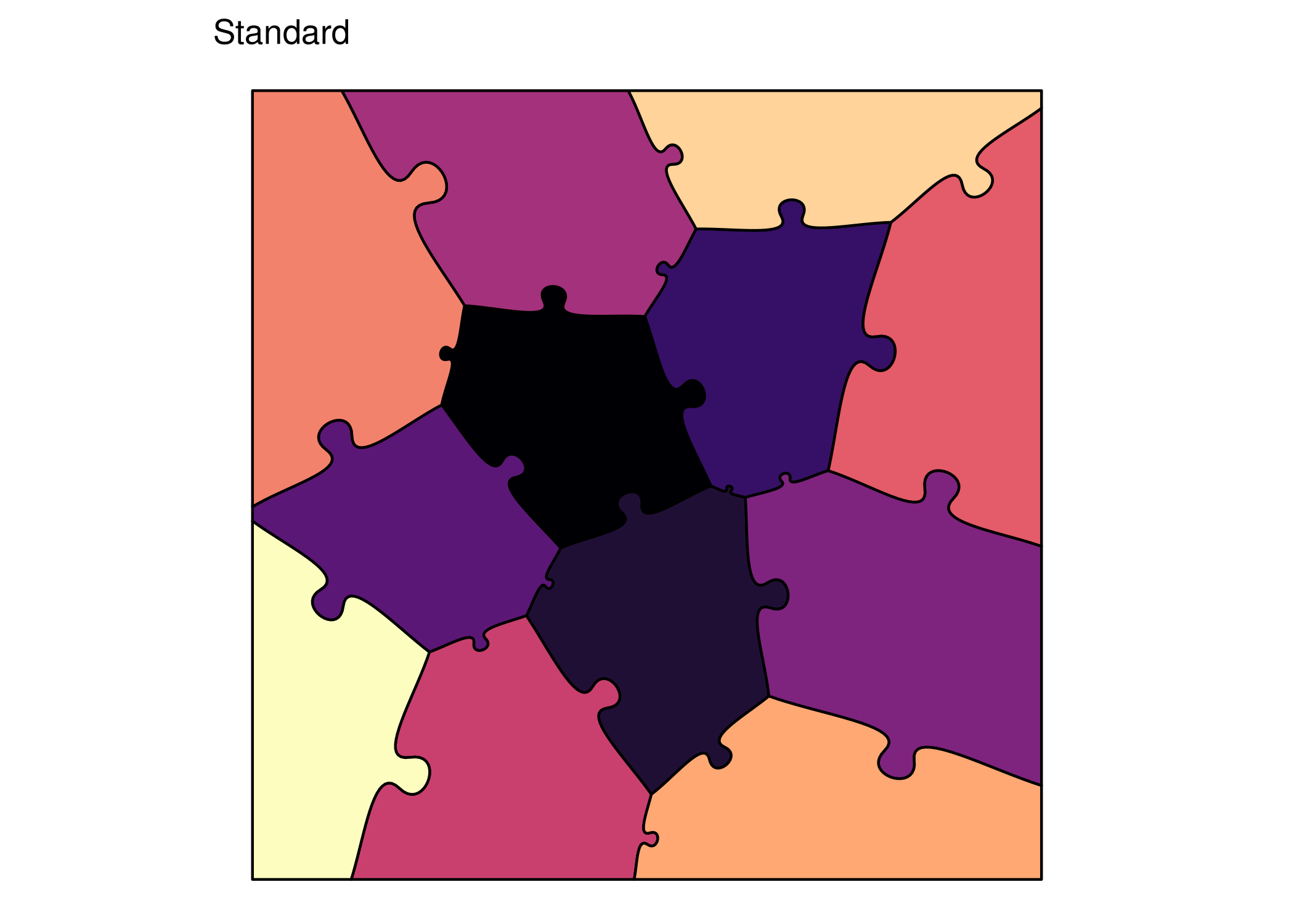
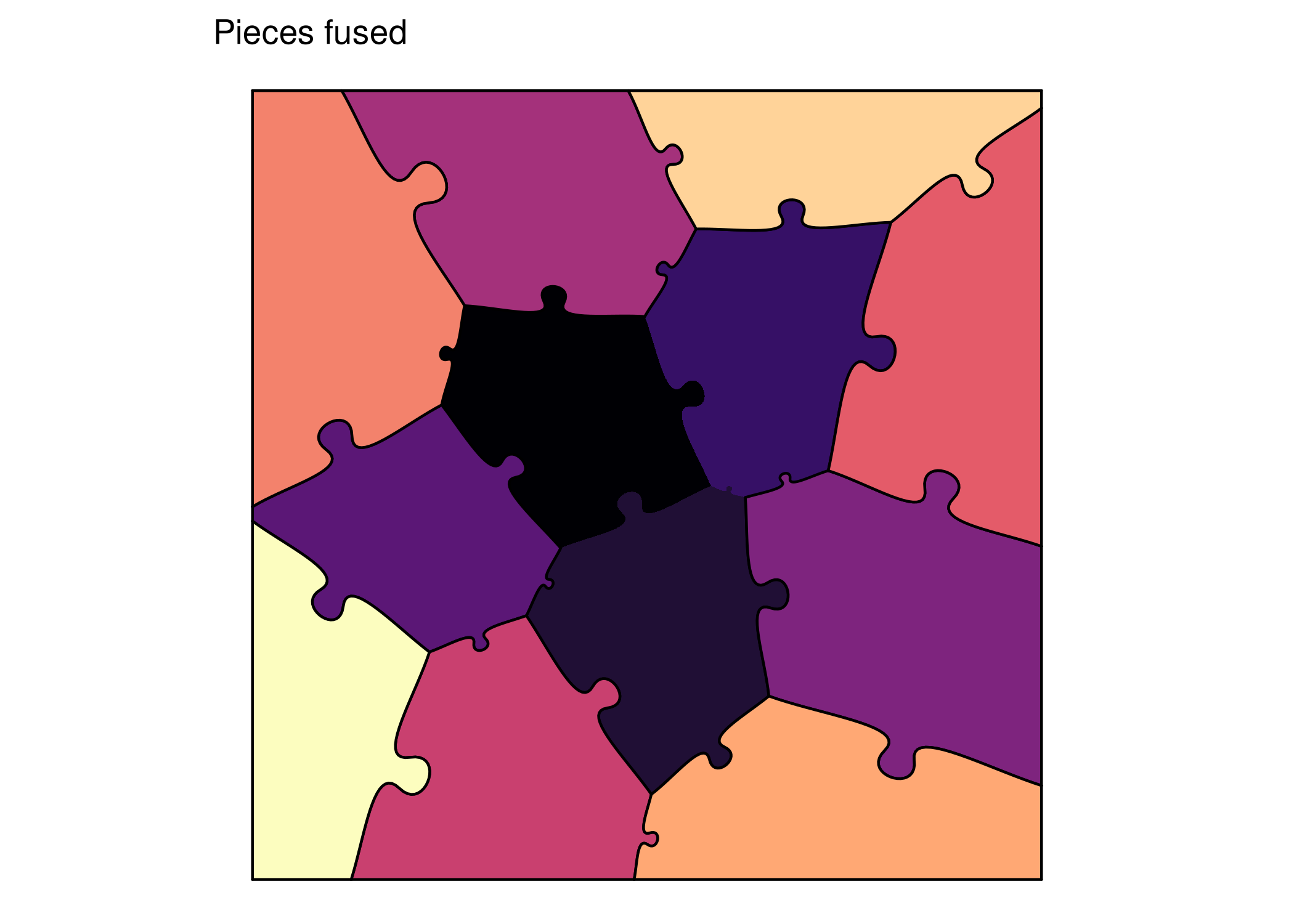
Fusion Groups
Merge pieces together using PILES notation:
# Standard print (ggplot () + geom_puzzle_voronoi (aes (fill = after_stat (piece_id)),n_cells = 12 ,seed = 42 + scale_fill_viridis_c (option = "magma" , guide = "none" ) + coord_fixed () + theme_puzzle () + labs (title = "Standard" ))# Adjacent pieces fused print (ggplot () + geom_puzzle_voronoi (aes (fill = after_stat (piece_id)),n_cells = 12 ,seed = 42 ,fusion_groups = "1-2-3,5-6" + scale_fill_viridis_c (option = "magma" , guide = "none" ) + coord_fixed () + theme_puzzle () + labs (title = "Pieces fused" ))
# Standard <- generate_puzzle (type = "voronoi" ,grid = c (12 ),size = c (200 , 200 ),seed = 42 ,fill_palette = "magma" render_puzzle_preview (result_standard, title = "Standard" )# Adjacent pieces fused <- generate_puzzle (type = "voronoi" ,grid = c (12 ),size = c (200 , 200 ),seed = 42 ,fill_palette = "magma" ,fusion_groups = "1-2-3,5-6" render_puzzle_preview (result_fused, title = "Pieces fused" )
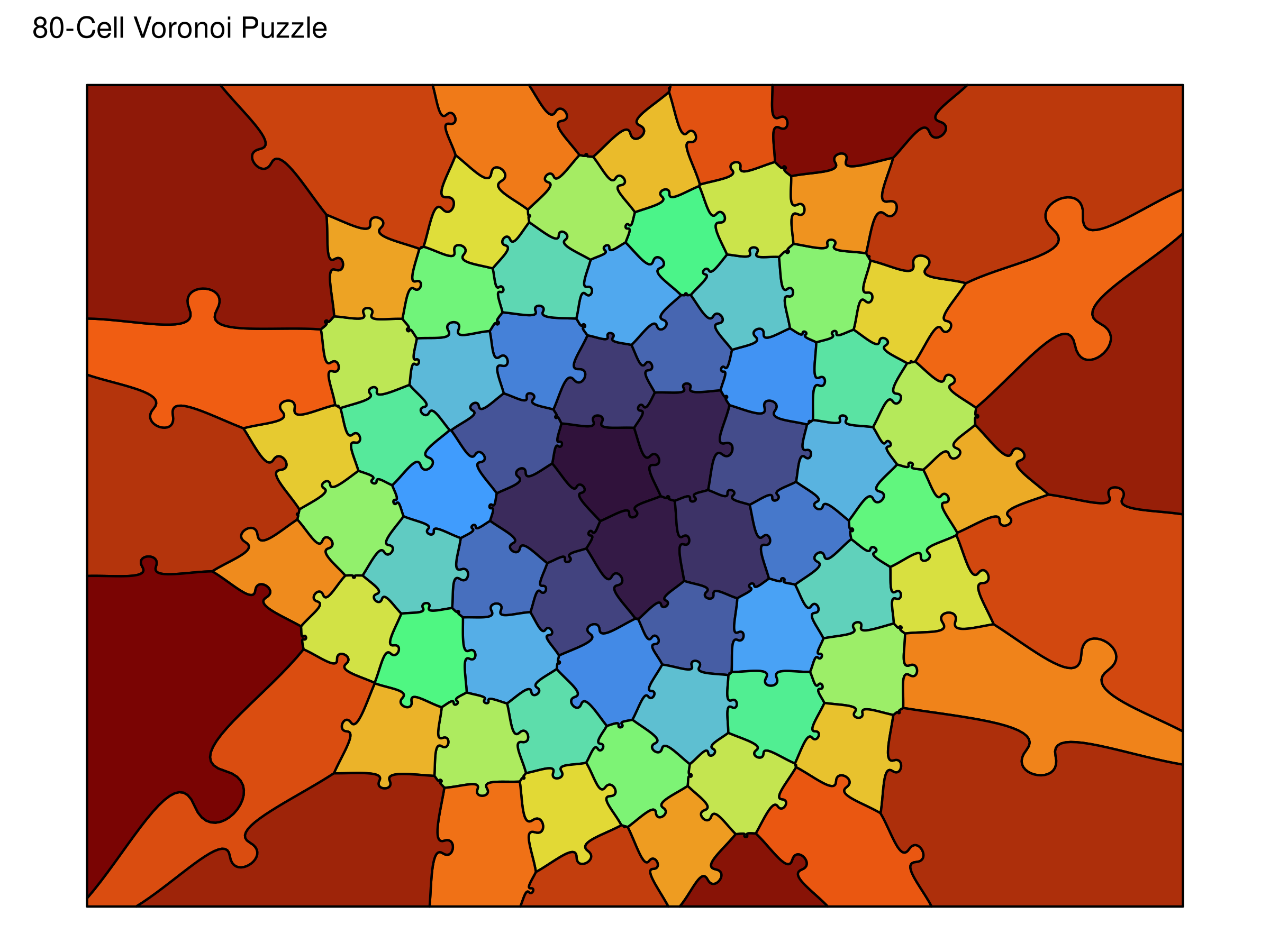
Large Voronoi Puzzle
ggplot () + geom_puzzle_voronoi (aes (fill = after_stat (piece_id)),n_cells = 80 ,width = 400 , height = 300 ,seed = 789 + scale_fill_viridis_c (option = "turbo" , guide = "none" ) + coord_fixed () + theme_puzzle () + labs (title = "80-Cell Voronoi Puzzle" )
<- generate_puzzle (type = "voronoi" ,grid = c (80 ),size = c (300 , 400 ),seed = 789 ,fill_palette = "turbo" render_puzzle_preview (result, max_width = "600px" )
Parameters Reference
n_cellsinteger
12
Number of Voronoi cells (pieces)
seedinteger
random
Random seed for reproducibility
offsetnumeric
0 (mm)
Piece separation distance
tabsizenumeric
6 (%)
Tab size as percentage of edge length
jitternumeric
2 (%)
Randomness in tab shape as percentage
min_tab_sizenumeric
0 (mm)
Minimum tab size in millimeters
max_tab_sizenumeric
Inf (mm)
Maximum tab size in millimeters
point_distributionstring
“fermat”
Seed point distribution method
fusion_groupsstring
NULL
PILES notation for fusing pieces
About Voronoi Tessellation
Voronoi tessellation divides a plane into regions based on distance to seed points. Each region consists of all points closer to its seed than to any other seed. This creates:
Convex polygons : Each piece is a convex polygonNatural appearance : Resembles patterns in natureVariable sizes : Piece sizes depend on seed point distribution
Code Example
ggplot () + geom_puzzle_voronoi (aes (fill = after_stat (piece_id)),n_cells = 35 ,width = 400 , height = 300 ,seed = 42 ,offset = 5 + scale_fill_viridis_c (option = "turbo" , guide = "none" ) + coord_fixed () + theme_puzzle ()
# Generate puzzle <- generate_puzzle (type = "voronoi" ,grid = c (35 ), # 35 cells size = c (300 , 400 ), # height=300mm, width=400mm seed = 42 ,offset = 5 # writeLines(result$svg_content, "voronoi_puzzle.svg") # Preview render_puzzle_preview (result)
When to Use Voronoi
Voronoi puzzles are ideal for:
Organic themes : Nature, landscapes, biological subjectsArtistic effects : Modern art, abstract designsVariable difficulty : More cells = harder puzzleUnique designs : Every seed creates a different pattern