# Basic parsing
result <- parse_piles("1-2-3,4-5")
print(result)
#> [[1]]
#> [1] 1 2 3
#>
#> [[2]]
#> [1] 4 5PILES Notation
Puzzle Input Line Entry System for piece fusion
Overview
PILES (Puzzle Input Line Entry System) is a SMILES-inspired notation for specifying which puzzle pieces should be fused together. It provides a concise, readable way to define fusion groups using piece IDs, ranges, and semantic keywords.
Basic Syntax
Single Fusion Group
Connect pieces with hyphens:
1-2-3 # Fuse pieces 1, 2, and 3Multiple Groups
Separate groups with commas:
1-2,3-4,5-6 # Three separate fusion groupsRanges
Use colon for consecutive ranges:
1:6 # Fuse pieces 1, 2, 3, 4, 5, 6Examples
Rectangular Grid
# Standard
print(ggplot() +
  geom_puzzle_rect(
    aes(fill = after_stat(piece_id)),
    cols = 4, rows = 3,
    width = 300, height = 225,
    seed = 42
  ) +
  scale_fill_viridis_c(guide = "none") +
  coord_fixed() +
  theme_puzzle() +
  labs(title = "Standard"))

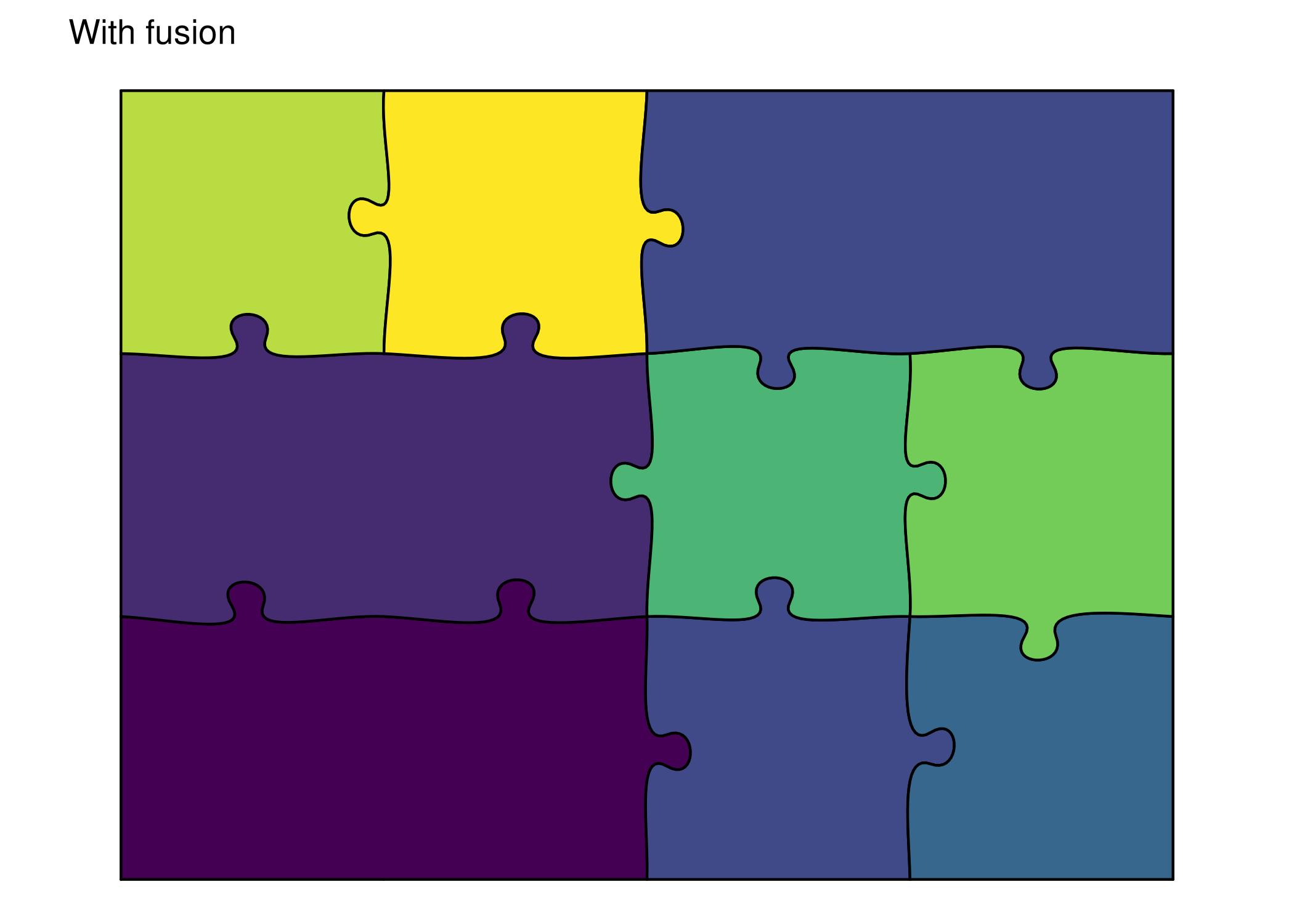
# With fusion
print(ggplot() +
  geom_puzzle_rect(
    aes(fill = after_stat(group_id)),
    cols = 4, rows = 3,
    width = 300, height = 225,
    seed = 42,
    fusion_groups = "1-2,5-6,11-12"
  ) +
  scale_fill_viridis_c(guide = "none") +
  coord_fixed() +
  theme_puzzle() +
  labs(title = "With fusion"))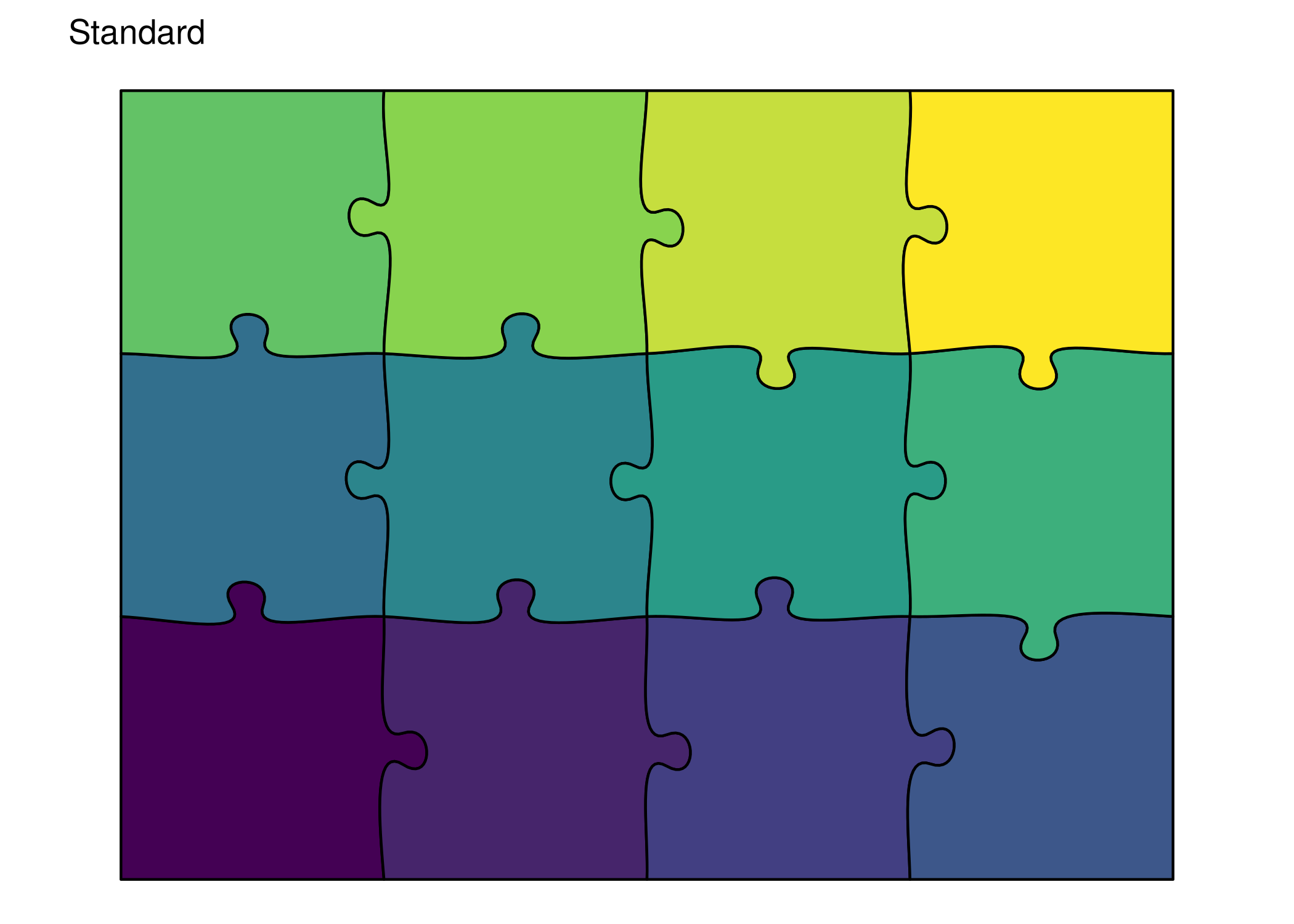
Hexagonal Keywords
# Center merged with ring 1
print(ggplot() +
  geom_puzzle_hex(
    aes(fill = after_stat(group_id)),
    rings = 3, diameter = 200, seed = 42,
    fusion_groups = "center-ring1"
  ) +
  scale_fill_viridis_c(option = "plasma", guide = "none") +
  coord_fixed() +
  theme_puzzle() +
  labs(title = "center-ring1"))

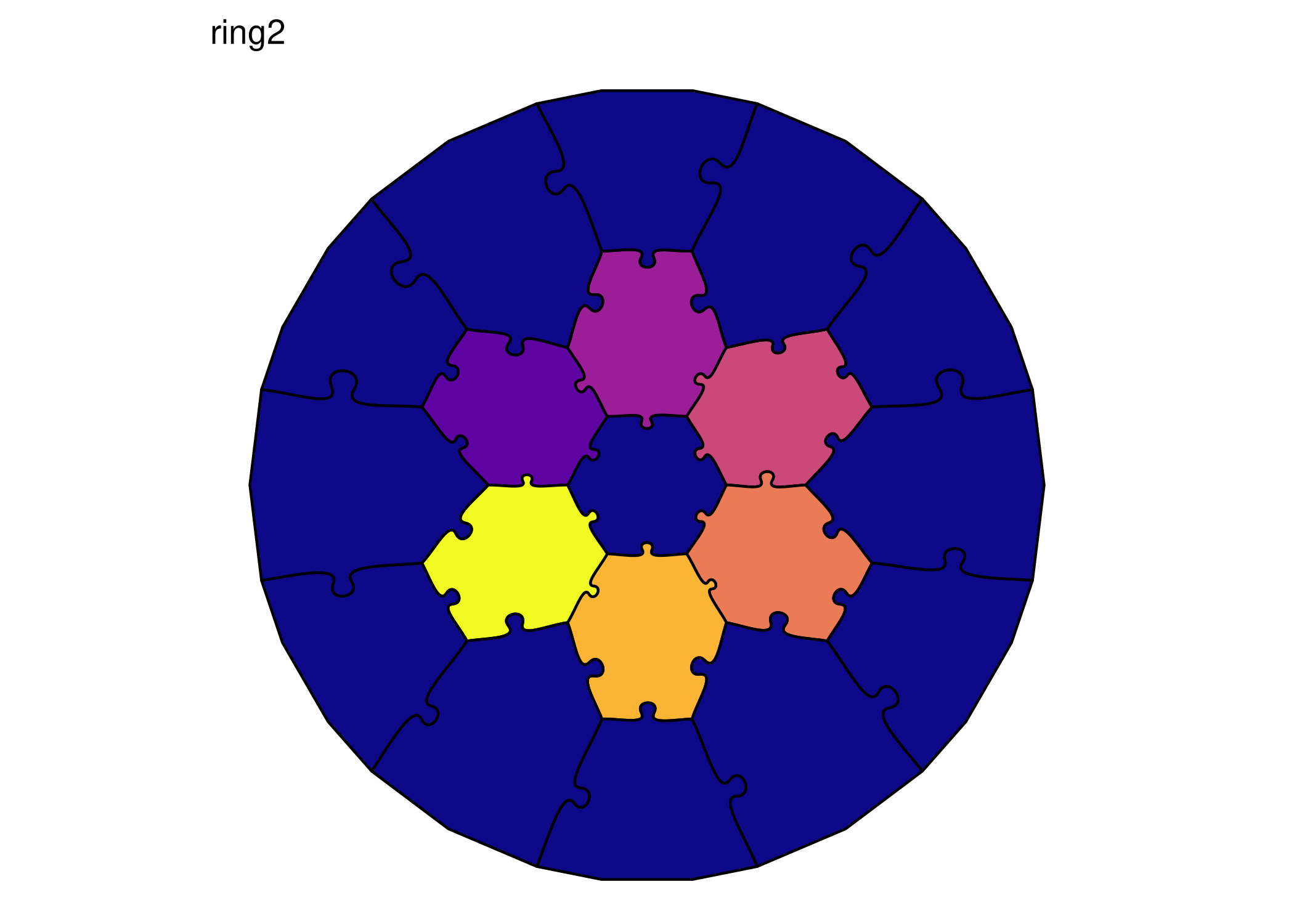
# Ring 2 merged
print(ggplot() +
  geom_puzzle_hex(
    aes(fill = after_stat(group_id)),
    rings = 3, diameter = 200, seed = 42,
    fusion_groups = "ring2"
  ) +
  scale_fill_viridis_c(option = "plasma", guide = "none") +
  coord_fixed() +
  theme_puzzle() +
  labs(title = "ring2"))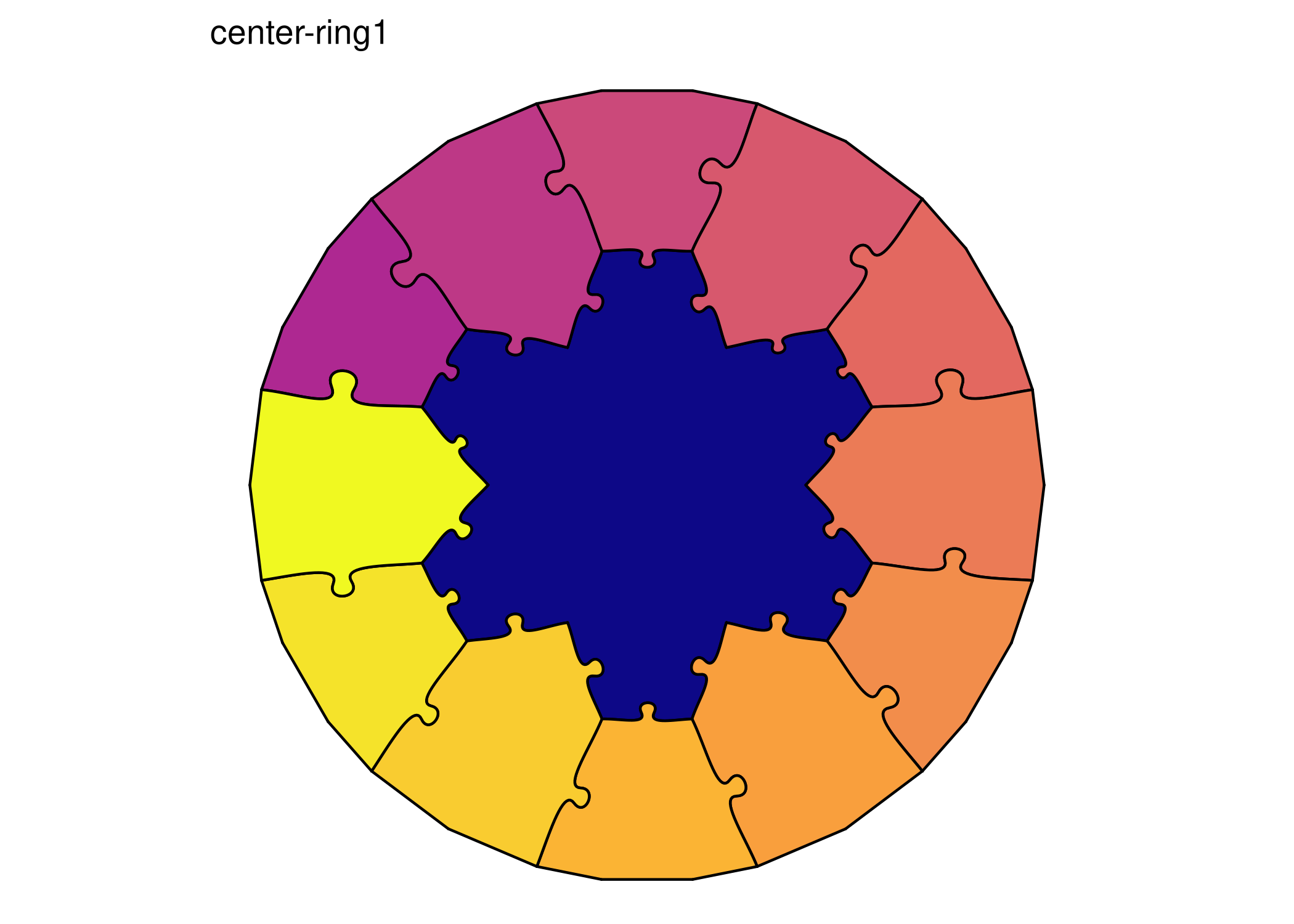
Keywords Reference
Hexagonal/Concentric Keywords
| Keyword | Description | Requires |
|---|---|---|
center |
Center piece (piece 1) | puzzle_result |
ring1 |
All pieces in ring 1 | puzzle_result |
ring2 |
All pieces in ring 2 | puzzle_result |
ringN |
All pieces in ring N | puzzle_result |
boundary |
All outer boundary pieces | puzzle_result |
Rectangular Keywords
| Keyword | Description | Requires |
|---|---|---|
R1 |
Row 1 (top) | puzzle_result |
R2 |
Row 2 | puzzle_result |
RN |
Row N | puzzle_result |
C1 |
Column 1 (left) | puzzle_result |
C2 |
Column 2 | puzzle_result |
CN |
Column N | puzzle_result |
boundary |
All edge pieces | puzzle_result |
Programmatic API
parse_piles()
Parse a PILES string into a list of piece ID vectors:
parse_fusion()
Auto-detect format and parse (requires puzzle result for keywords):
# With puzzle result for keyword expansion
puzzle <- generate_puzzle(
  type = "hexagonal",
  grid = c(3),
  size = c(200),
  seed = 42
)

groups <- parse_fusion("center-ring1", puzzle)
to_piles()
Convert a list of groups back to PILES notation:
groups <- list(c(1, 2, 3), c(4, 5))
notation <- to_piles(groups)
print(notation)
#> [1] "1:3,4-5"
validate_piles_syntax()
Check if a PILES string is syntactically valid:
validate_piles_syntax("1-2-3,4-5")      # TRUE
#> $valid
#> [1] TRUE
#>
#> $message
#> [1] "Valid PILES syntax"
#>
#> $warnings
#> character(0)
validate_piles_syntax("1-2(-3)")        # FALSE (invalid)
#> $valid
#> [1] TRUE
#>
#> $message
#> [1] "Valid PILES syntax"
#>
#> $warnings
#> character(0)
Complex Examples
Row Fusion
# Fuse each row
ggplot() +
  geom_puzzle_rect(
    aes(fill = after_stat(group_id)),
    cols = 5, rows = 3,
    width = 400, height = 240,
    seed = 42,
    fusion_groups = "R1,R2,R3"
  ) +
  scale_fill_viridis_c(
    option = "magma",
    name = "Row"
  ) +
  coord_fixed() +
  theme_minimal() +
  labs(title = "Row Fusion: R1, R2, R3")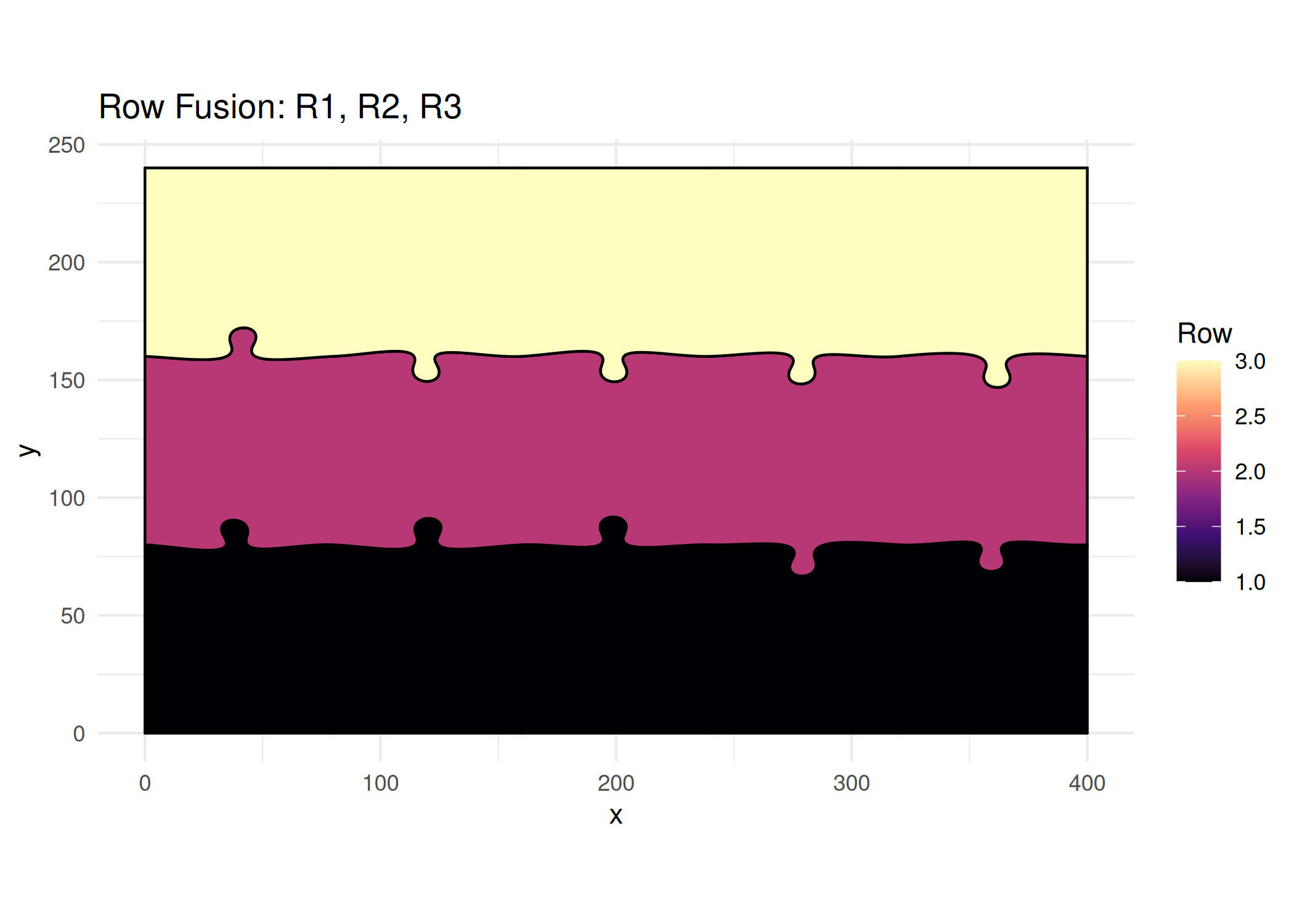
Column Fusion
# Fuse each column
ggplot() +
  geom_puzzle_rect(
    aes(fill = after_stat(group_id)),
    cols = 4, rows = 4,
    width = 320, height = 320,
    seed = 42,
    fusion_groups = "C1,C2,C3,C4"
  ) +
  scale_fill_viridis_c(
    option = "cividis",
    name = "Column"
  ) +
  coord_fixed() +
  theme_minimal() +
  labs(title = "Column Fusion: C1, C2, C3, C4")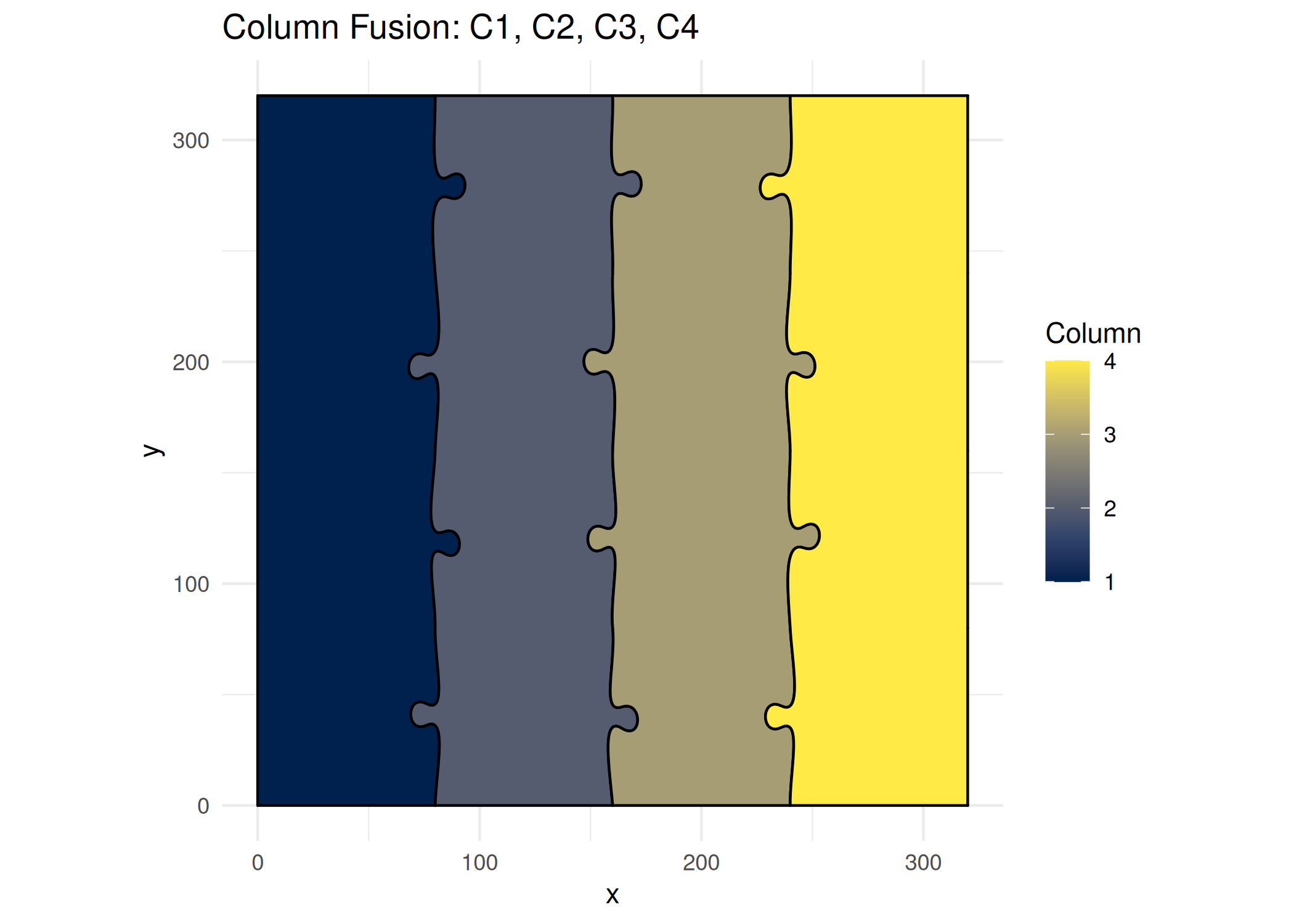
Mixed Notation
Combine different notations in one string:
# Numeric IDs + ranges
"1-2,5:8,10-11-12"
#> [1] "1-2,5:8,10-11-12"

# Keywords + IDs
"center-1,ring2"
#> [1] "center-1,ring2"
Validation Rules
- Piece IDs must exist: IDs must be valid for the puzzle
- No duplicates in group: Each piece can only appear once per group
- Adjacent pieces recommended: For visual coherence, fused pieces should be neighbors
Error Handling
# Invalid syntax
tryCatch(
  validate_piles_syntax("1-2(-3)"),
  error = function(e) message("Error: ", e$message)
)
#> $valid
#> [1] TRUE
#>
#> $message
#> [1] "Valid PILES syntax"
#>
#> $warnings
#> character(0)
Best Practices
- Use keywords for semantics:
ring1is clearer than2-3-4-5-6-7 - Group logically: Keep related pieces in the same fusion group
- Validate first: Use
validate_piles_syntax()before generating - Consider adjacency: Non-adjacent fused pieces may look disconnected
PILES vs Other Formats
| Format | Example | Notes |
|---|---|---|
| PILES | 1-2-3,4-5 |
Compact, human-readable |
| List | list(c(1,2,3), c(4,5)) |
Programmatic R format |
| JSON | [[1,2,3],[4,5]] |
For API interchange |
Convert between formats:
# PILES to list
groups <- parse_piles("1-2-3,4-5")
print(groups)
#> [[1]]
#> [1] 1 2 3
#>
#> [[2]]
#> [1] 4 5

# List to PILES
notation <- to_piles(groups)
print(notation)
#> [1] "1:3,4-5"
See Also
- generate_puzzle() - Main API with fusion parameter
- ggpuzzle Extension - ggplot2 integration
- PILES Documentation - Full specification