Overview
Hexagonal puzzles create stunning honeycomb patterns. Each hexagonal piece connects to up to six neighbors through elegantly curved tabs. The result is a visually striking circular puzzle.
Ring Variations
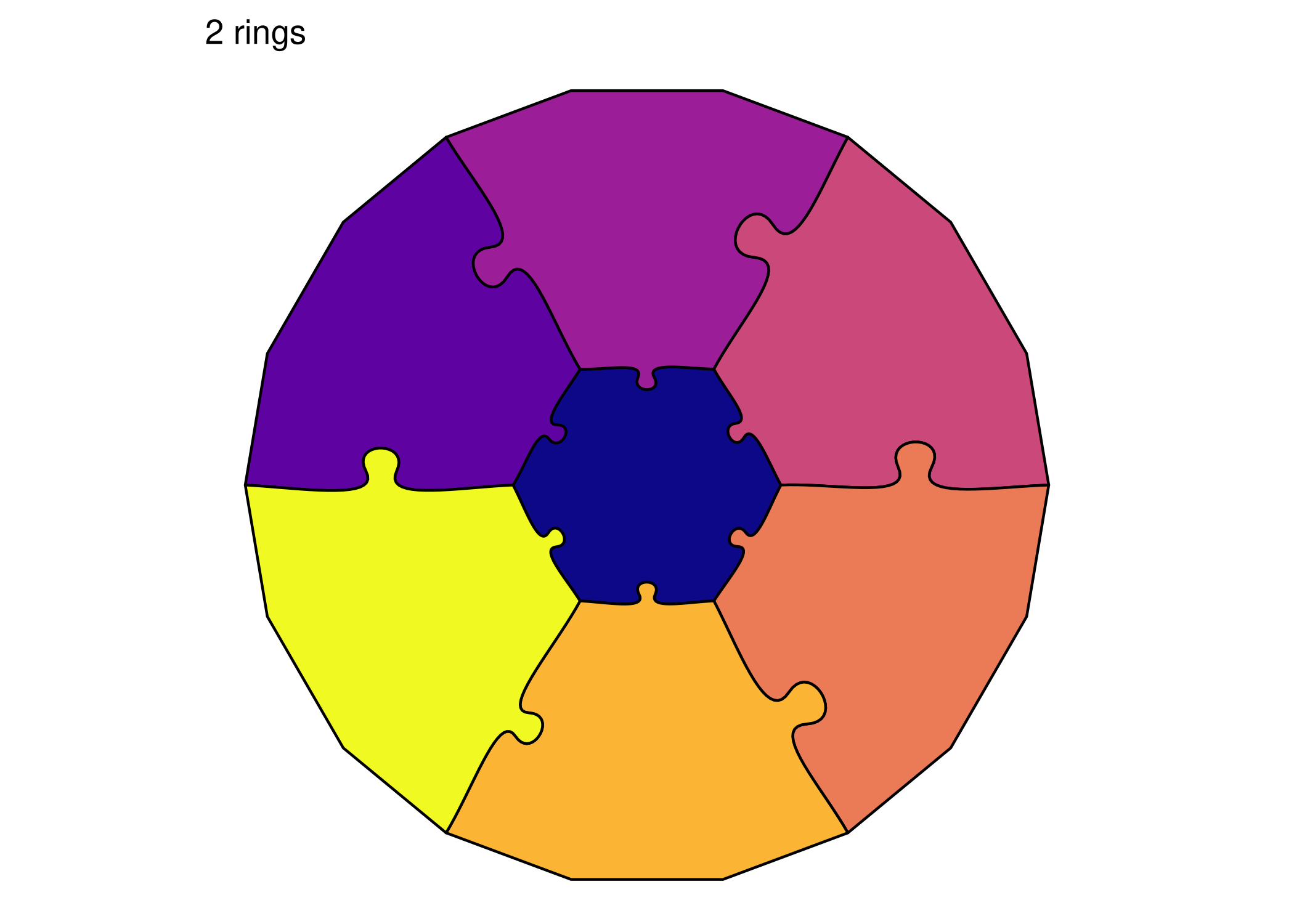
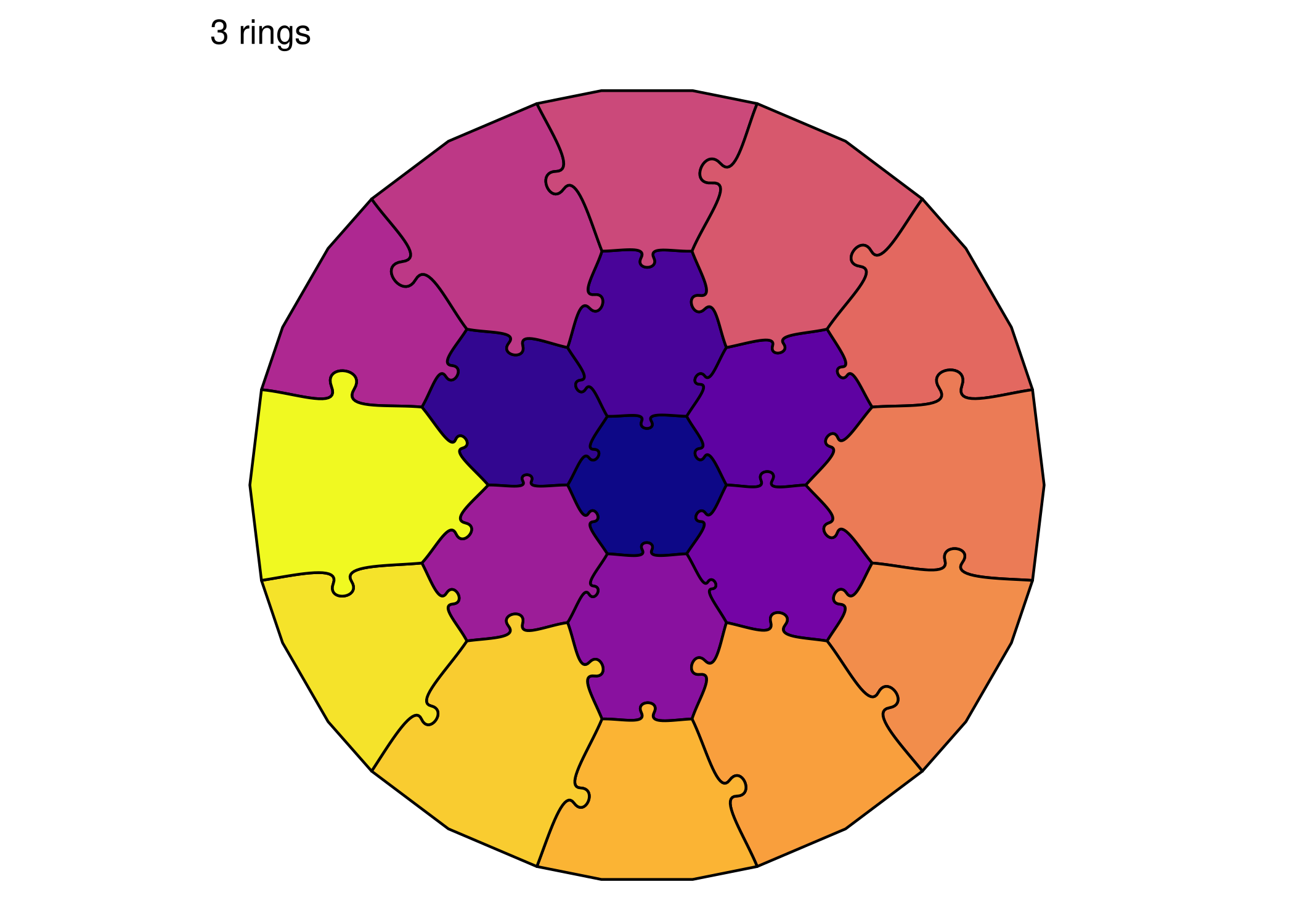
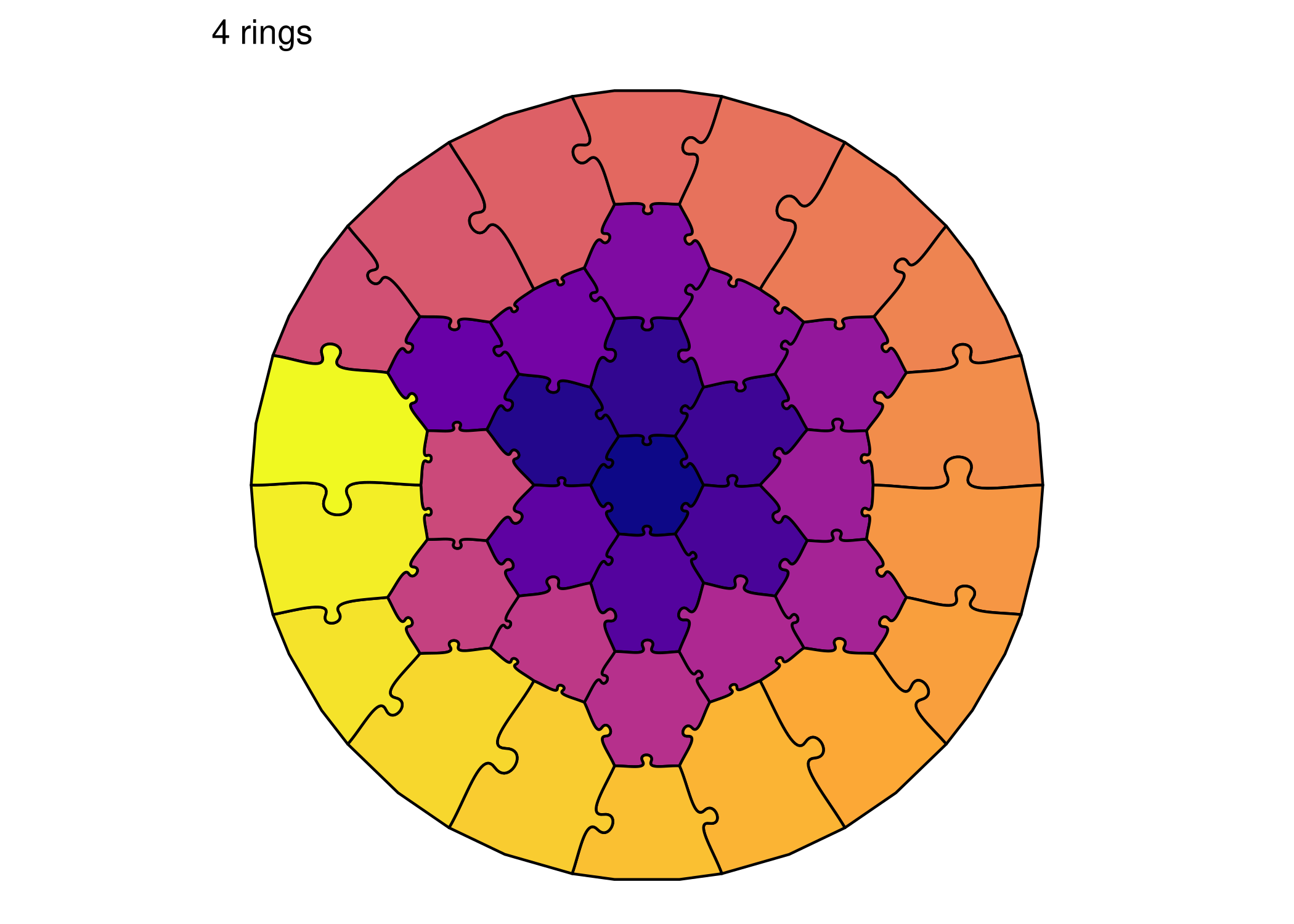
Hexagonal puzzles are defined by the number of rings:
# 2 rings print (ggplot () + geom_puzzle_hex (aes (fill = after_stat (piece_id)),rings = 2 , seed = 42 + scale_fill_viridis_c (option = "plasma" , guide = "none" ) + coord_fixed () + theme_puzzle () + labs (title = "2 rings" ))# 3 rings print (ggplot () + geom_puzzle_hex (aes (fill = after_stat (piece_id)),rings = 3 , seed = 42 + scale_fill_viridis_c (option = "plasma" , guide = "none" ) + coord_fixed () + theme_puzzle () + labs (title = "3 rings" ))# 4 rings print (ggplot () + geom_puzzle_hex (aes (fill = after_stat (piece_id)),rings = 4 , seed = 42 + scale_fill_viridis_c (option = "plasma" , guide = "none" ) + coord_fixed () + theme_puzzle () + labs (title = "4 rings" ))
# 2 rings <- generate_puzzle (type = "hexagonal" ,grid = c (2 ),size = c (200 ),seed = 42 ,do_warp = TRUE ,do_trunc = TRUE ,fill_palette = "plasma" render_puzzle_preview (result_2) # 2 rings # 3 rings <- generate_puzzle (type = "hexagonal" ,grid = c (3 ),size = c (200 ),seed = 42 ,do_warp = TRUE ,do_trunc = TRUE ,fill_palette = "plasma" render_puzzle_preview (result_3) # 3 rings # 4 rings <- generate_puzzle (type = "hexagonal" ,grid = c (4 ),size = c (200 ),seed = 42 ,do_warp = TRUE ,do_trunc = TRUE ,fill_palette = "plasma" render_puzzle_preview (result_4) # 4 rings
Warp and Truncation
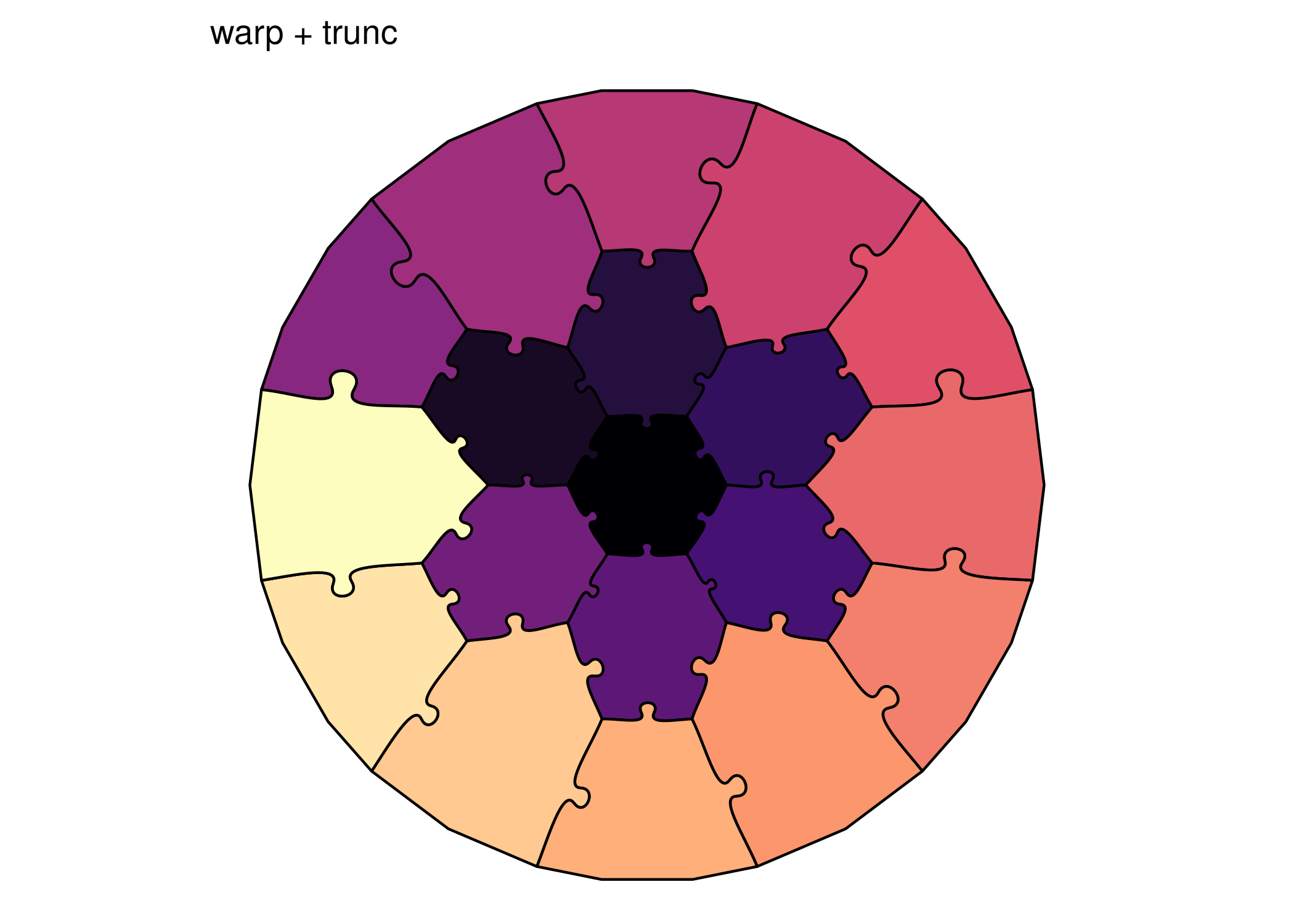
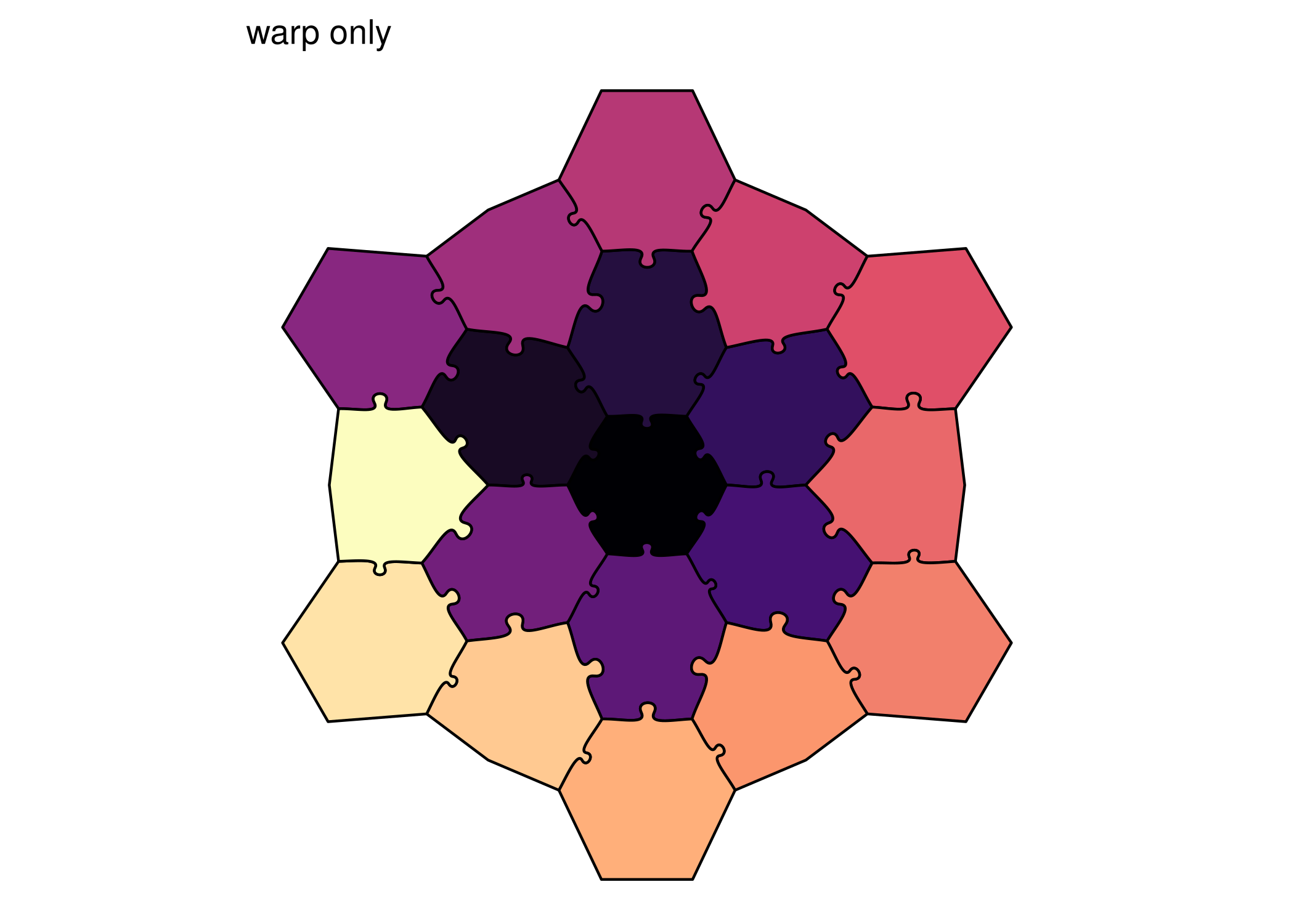
Hexagonal puzzles support two key transformations:
# Default: warped and truncated print (ggplot () + geom_puzzle_hex (aes (fill = after_stat (piece_id)),rings = 3 ,do_warp = TRUE , do_trunc = TRUE ,seed = 42 + scale_fill_viridis_c (option = "magma" , guide = "none" ) + coord_fixed () + theme_puzzle () + labs (title = "warp + trunc" ))# Warped but not truncated (extends beyond circle) print (ggplot () + geom_puzzle_hex (aes (fill = after_stat (piece_id)),rings = 3 ,do_warp = TRUE , do_trunc = FALSE ,seed = 42 + scale_fill_viridis_c (option = "magma" , guide = "none" ) + coord_fixed () + theme_puzzle () + labs (title = "warp only" ))
# Default: warped and truncated <- generate_puzzle (type = "hexagonal" ,grid = c (3 ),size = c (200 ),seed = 42 ,do_warp = TRUE ,do_trunc = TRUE ,fill_palette = "magma" render_puzzle_preview (result_warp_trunc)# Warped but not truncated <- generate_puzzle (type = "hexagonal" ,grid = c (3 ),size = c (200 ),seed = 42 ,do_warp = TRUE ,do_trunc = FALSE ,fill_palette = "magma" render_puzzle_preview (result_warp_only)
Color Palettes
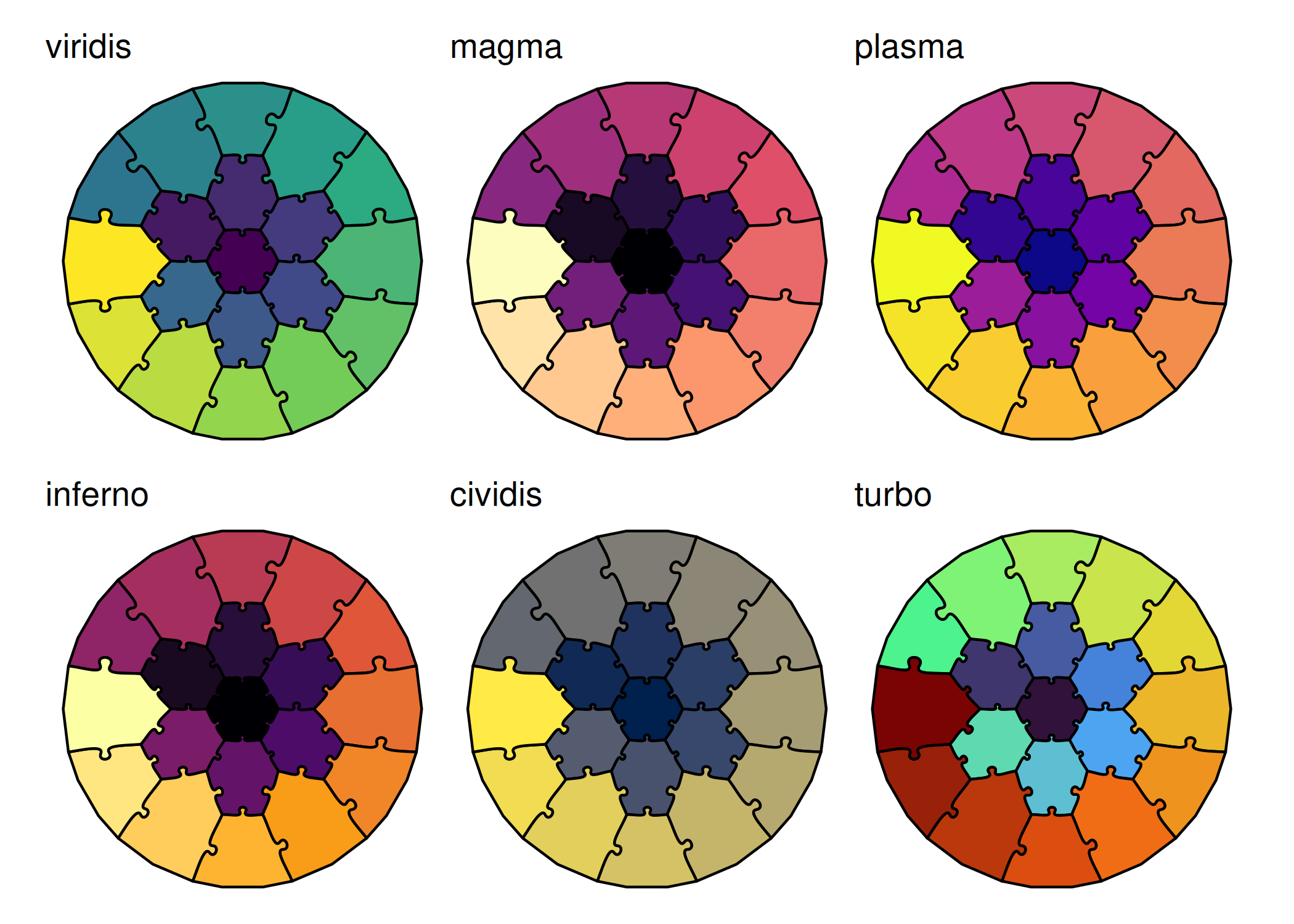
<- function (pal) {ggplot () + geom_puzzle_hex (aes (fill = after_stat (piece_id)),rings = 3 , seed = 42 + scale_fill_viridis_c (option = pal, guide = "none" ) + coord_fixed () + theme_puzzle () + labs (title = pal)print ((make_hex_palette ("viridis" ) + make_hex_palette ("magma" ) + make_hex_palette ("plasma" )) / make_hex_palette ("inferno" ) + make_hex_palette ("cividis" ) + make_hex_palette ("turbo" )))
# Generate all palette previews and combine into a grid <- c ("viridis" , "magma" , "plasma" , "inferno" , "cividis" , "turbo" )<- lapply (palettes, function (pal) {generate_puzzle (type = "hexagonal" , grid = c (3 ), size = c (200 ), seed = 42 , do_warp = TRUE , do_trunc = TRUE , fill_palette = pal)render_puzzle_grid (items, ncol = 3 , labels = palettes)
Fill Direction
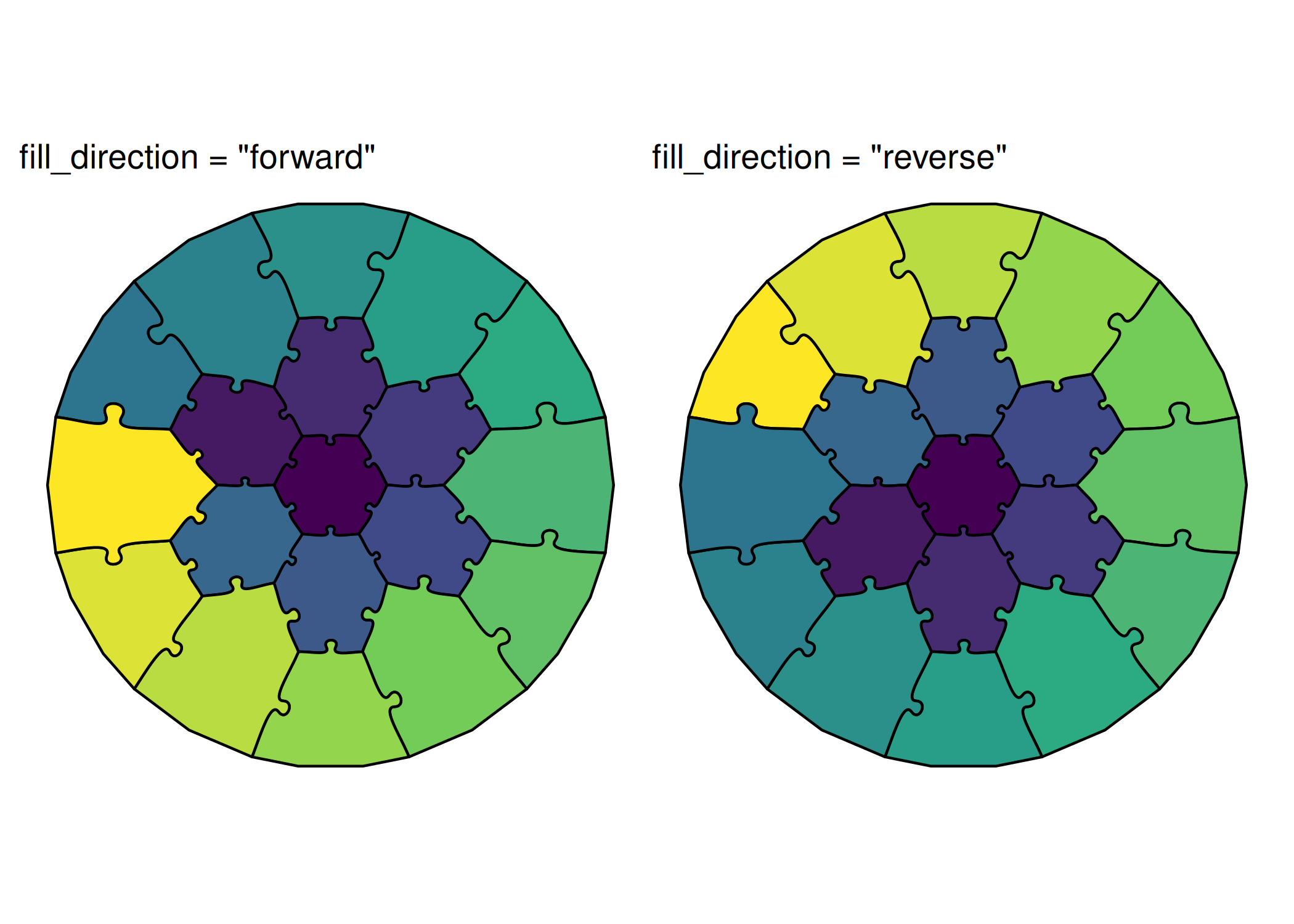
Control the spatial order of color assignment. For hexagonal puzzles, "reverse" reverses colors within each ring while keeping the center piece unchanged. This is distinct from palette_invert which reverses the dark↔︎light ends of the palette.
<- function (dir) {ggplot () + geom_puzzle_hex (aes (fill = after_stat (fill_order)),rings = 3 ,fill_direction = dir,seed = 42 + scale_fill_viridis_c (option = "viridis" , guide = "none" ) + coord_fixed () + theme_puzzle () + labs (title = paste0 ("fill_direction = \" " , dir, " \" " ))print (make_direction_plot ("forward" ) + make_direction_plot ("reverse" ))
<- c ("forward" , "reverse" )<- lapply (directions, function (dir) {generate_puzzle (type = "hexagonal" , grid = c (3 ), size = c (200 ), seed = 42 , do_warp = TRUE , do_trunc = TRUE , fill_palette = "viridis" , fill_direction = dir)render_puzzle_grid (items, ncol = 2 , labels = paste0 ("fill_direction = \" " , directions, " \" " ))
Offset (Separation)
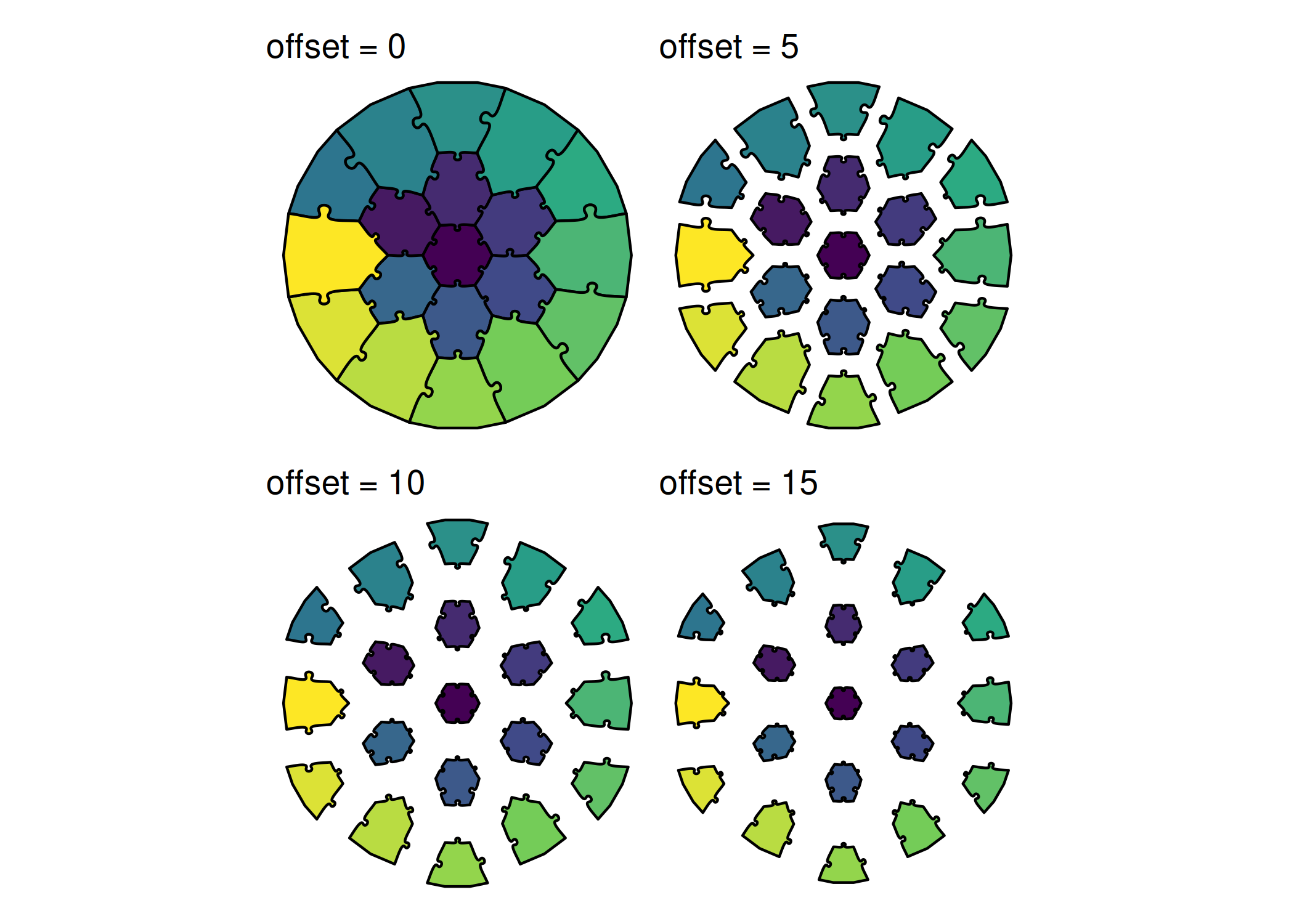
<- function (off) {ggplot () + geom_puzzle_hex (aes (fill = after_stat (piece_id)),rings = 3 ,offset = off, seed = 42 + scale_fill_viridis_c (option = "viridis" , guide = "none" ) + coord_fixed () + theme_puzzle () + labs (title = paste0 ("offset = " , off))print (make_hex_offset (0 ) + make_hex_offset (5 ) + make_hex_offset (10 ) + make_hex_offset (15 ))
# Generate offset previews in a grid <- c (0 , 5 , 10 , 15 )<- lapply (offsets, function (off) {generate_puzzle (type = "hexagonal" , grid = c (3 ), size = c (200 ), seed = 42 , do_warp = TRUE , do_trunc = TRUE , offset = off, fill_palette = "viridis" )render_puzzle_grid (items, ncol = 4 , labels = paste ("offset =" , offsets))
Fusion Groups
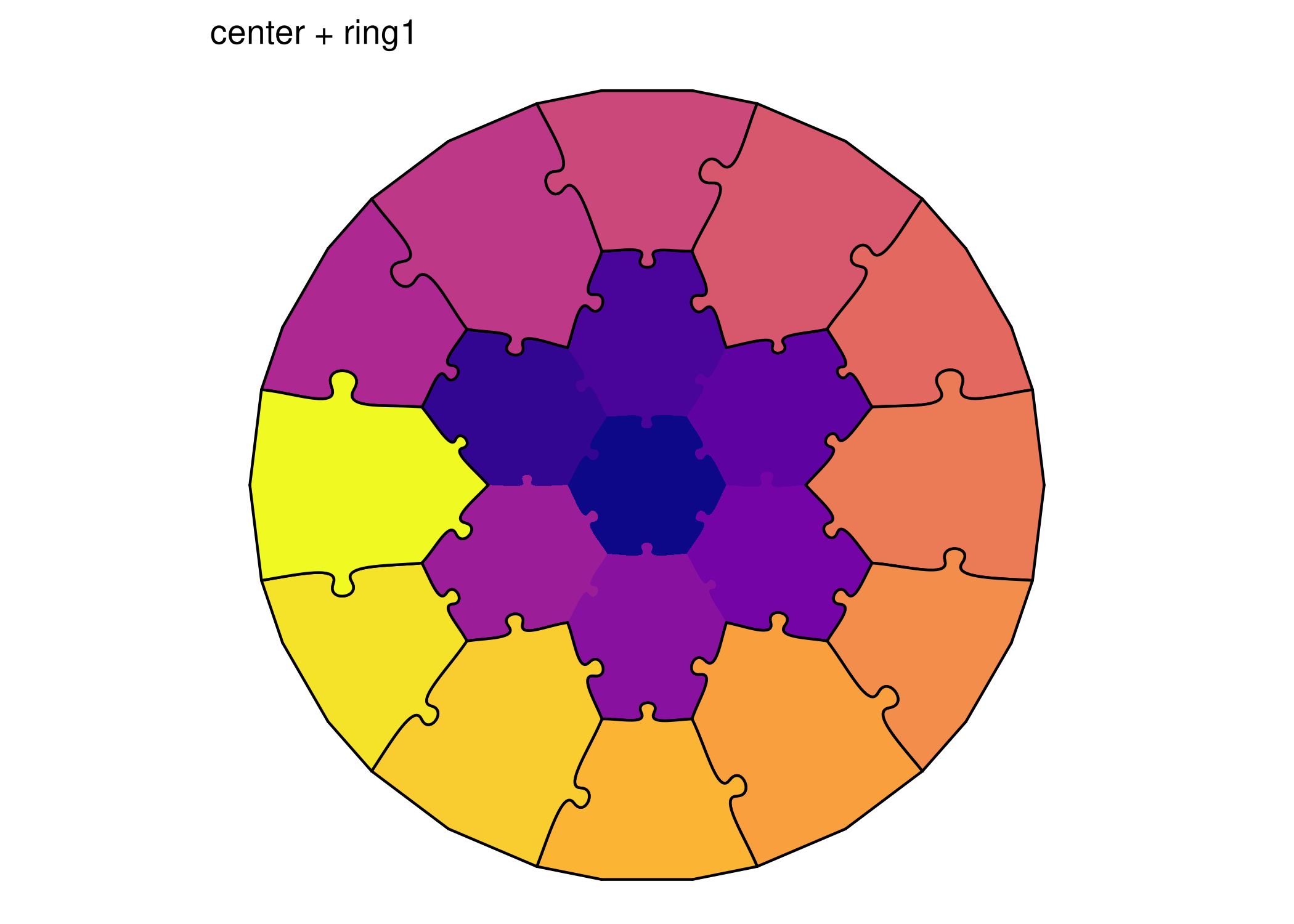
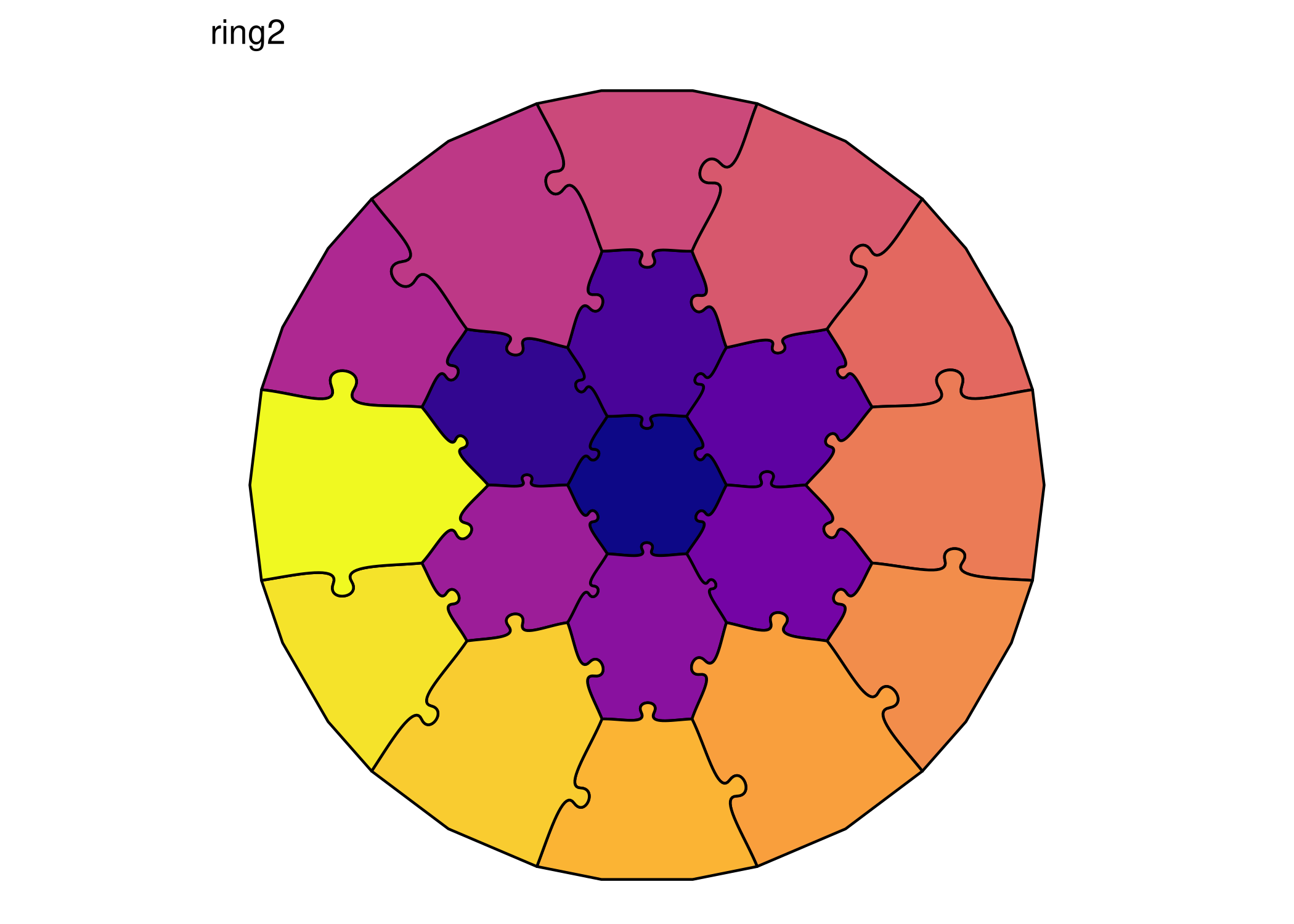
Special keywords for hexagonal puzzles:
# Center merged with ring 1 print (ggplot () + geom_puzzle_hex (aes (fill = after_stat (piece_id)),rings = 3 ,fusion_groups = "center-ring1" ,seed = 42 + scale_fill_viridis_c (option = "plasma" , guide = "none" ) + coord_fixed () + theme_puzzle () + labs (title = "center + ring1" ))# Ring 2 pieces merged print (ggplot () + geom_puzzle_hex (aes (fill = after_stat (piece_id)),rings = 3 ,fusion_groups = "ring2" ,seed = 42 + scale_fill_viridis_c (option = "plasma" , guide = "none" ) + coord_fixed () + theme_puzzle () + labs (title = "ring2" ))
# Center merged with ring 1 <- generate_puzzle (type = "hexagonal" ,grid = c (3 ),size = c (200 ),seed = 42 ,do_warp = TRUE ,do_trunc = TRUE ,fusion_groups = "center-ring1" ,fill_palette = "plasma" render_puzzle_preview (result_center_ring1)# Ring 2 pieces merged <- generate_puzzle (type = "hexagonal" ,grid = c (3 ),size = c (200 ),seed = 42 ,do_warp = TRUE ,do_trunc = TRUE ,fusion_groups = "ring2" ,fill_palette = "plasma" render_puzzle_preview (result_ring2)
Large Puzzles
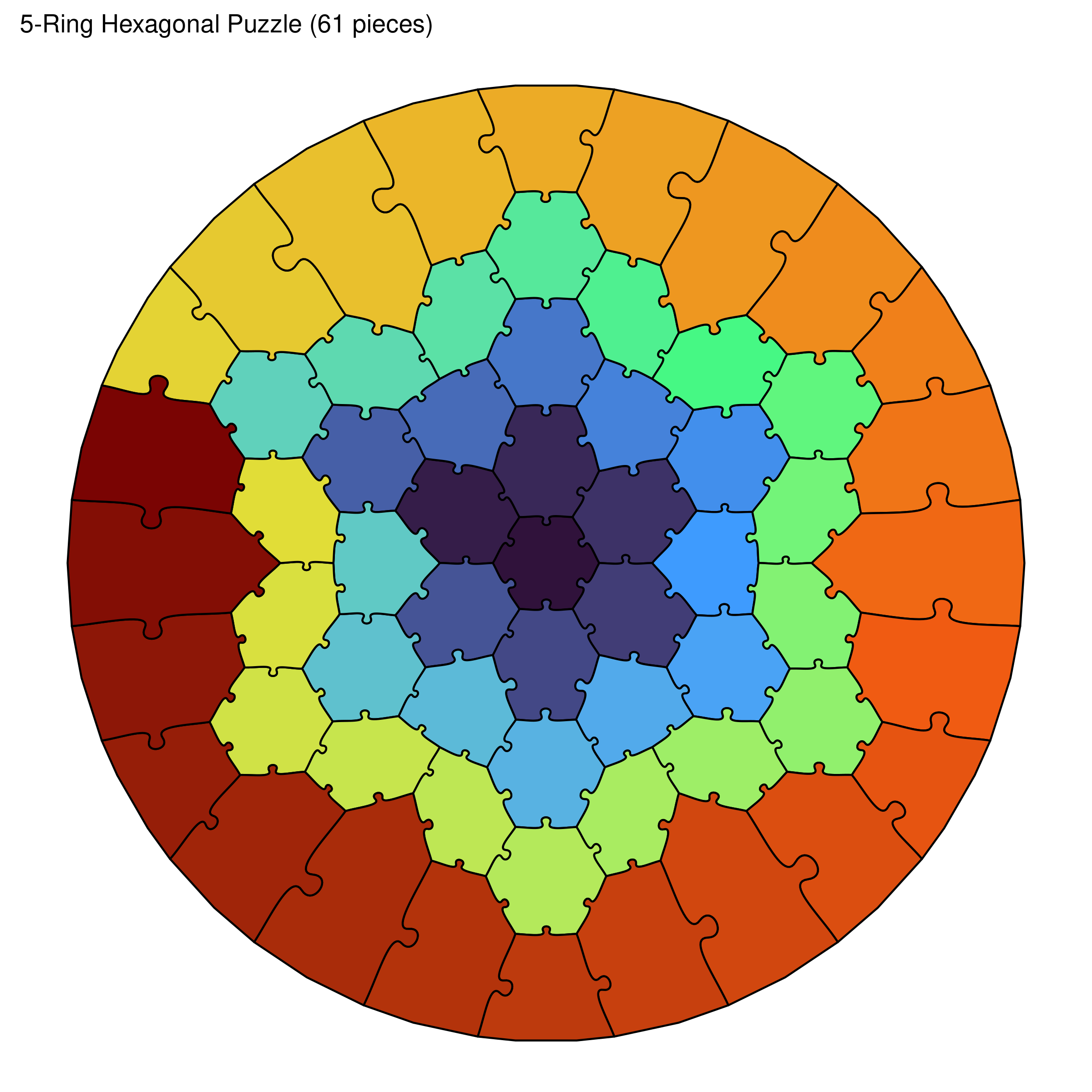
ggplot () + geom_puzzle_hex (aes (fill = after_stat (piece_id)),rings = 5 ,seed = 123 + scale_fill_viridis_c (option = "turbo" , guide = "none" ) + coord_fixed () + theme_puzzle () + labs (title = "5-Ring Hexagonal Puzzle (61 pieces)" )
<- generate_puzzle (type = "hexagonal" ,grid = c (5 ),size = c (300 ),seed = 123 ,do_warp = TRUE ,do_trunc = TRUE ,fill_palette = "turbo" render_puzzle_preview (result, max_width = "500px" )
Parameters Reference
ringsinteger
3
Number of concentric rings
seedinteger
random
Random seed for reproducibility
offsetnumeric
0 (mm)
Piece separation distance
tabsizenumeric
6 (%)
Tab size as percentage of edge length
jitternumeric
2 (%)
Randomness in tab shape as percentage
min_tab_sizenumeric
0 (mm)
Minimum tab size in millimeters
max_tab_sizenumeric
Inf (mm)
Maximum tab size in millimeters
do_warplogical
FALSE (API) / TRUE (ggpuzzle)
Apply circular warping
do_trunclogical
FALSE (API) / TRUE (ggpuzzle)
Truncate to boundary
fusion_groupsstring
NULL
PILES notation for fusing pieces
PILES Keywords
Special keywords available for hexagonal puzzles:
centerThe center piece (piece 1)
ring1All pieces in ring 1
ring2All pieces in ring 2
ringNAll pieces in ring N
boundaryAll outer boundary pieces
Code Example
# Generate puzzle <- generate_puzzle (type = "hexagonal" ,grid = c (4 ), # 4 rings size = c (250 ), # 250mm diameter seed = 42 ,do_warp = TRUE ,do_trunc = TRUE ,offset = 5 # writeLines(result$svg_content, "hexagonal_puzzle.svg") render_puzzle_preview (result)# Access piece info <- length (result$ pieces):: cli_alert_info ("Generated {n_pieces} pieces" )