# Rectangular puzzle
rect <- generate_puzzle(
type = "rectangular",
grid = c(3, 4),
size = c(300, 400),
seed = 42
)
n_pieces <- length(rect$pieces)
cli::cli_alert_info("Generated {n_pieces} pieces")generate_puzzle()
The main entry point for creating puzzles
Description
generate_puzzle() is the unified entry point for creating all puzzle types in jigsawR. It handles rectangular, hexagonal, concentric, voronoi, random, and SNIC puzzles through a single consistent interface.
Usage
generate_puzzle(
  type = "rectangular",
  grid,
  size,
  seed = NULL,
  offset = 0,
  layout = "grid",
  fusion_groups = NULL,
  save_files = FALSE,
  output_dir = "output",
  ...
)
Arguments
Required Parameters
| Parameter | Type | Description |
|---|---|---|
type |
string | Puzzle type: "rectangular", "hexagonal", "concentric", "voronoi", "random", "snic" |
grid |
numeric vector | Grid dimensions (interpretation depends on type) |
size |
numeric vector | Physical dimensions in mm |
Grid Parameter by Type
| Type | Grid Format | Example |
|---|---|---|
| rectangular | c(rows, cols) |
c(3, 4) = 3x4 grid |
| hexagonal | c(rings) |
c(3) = 3 rings |
| concentric | c(rings) |
c(4) = 4 rings |
| voronoi | c(n_cells) |
c(25) = 25 cells |
| random | c(n_interior) |
c(10) = 10 interior points |
| snic | c(n_cells) |
c(30) = 30 superpixel cells |
Size Parameter by Type
| Type | Size Format | Example |
|---|---|---|
| rectangular | c(height, width) |
c(300, 400) = 300mm tall, 400mm wide |
| hexagonal | c(diameter) |
c(250) |
| concentric | c(diameter) |
c(200) |
| voronoi | c(height, width) |
c(300, 400) = 300mm tall, 400mm wide |
| random | c(height, width) |
c(300, 400) = 300mm tall, 400mm wide |
| snic | c(height, width) |
c(300, 400) = 300mm tall, 400mm wide |
Optional Parameters
| Parameter | Type | Default | Description |
|---|---|---|---|
seed |
integer | random | Random seed for reproducibility |
offset |
numeric (mm) | 0 | Piece separation distance |
layout |
string | “grid” | Layout algorithm: "grid" or "repel" |
repel_margin |
numeric (mm) | 2 | Minimum margin between pieces when layout = "repel" |
repel_max_iter |
integer | 100 | Maximum iterations for repel layout algorithm |
fusion_groups |
string | NULL | PILES notation for merging pieces |
save_files |
logical | FALSE | Whether to save SVG files |
output_dir |
string | “output” | Directory for saved files |
Type-Specific Parameters (via ...)
Common (all types):
| Parameter | Type | Default | Description |
|---|---|---|---|
tabsize |
numeric (%) | 6 | Tab size as percentage of edge length |
jitter |
numeric (%) | 2 | Randomness in tab shape as percentage |
stroke_width |
numeric (mm) | 1 | SVG stroke width |
min_tab_size |
numeric (mm) | NULL | Minimum tab size constraint (all types) |
max_tab_size |
numeric (mm) | NULL | Maximum tab size constraint (all types) |
fill_palette |
string | NULL | Color palette for fills: "viridis", "magma", "plasma", etc. |
fill_direction |
string | “forward” | Spatial color order: "forward" or "reverse" |
palette_invert |
logical | FALSE | Invert palette (dark↔︎light ends) |
Hexagonal/Concentric:
| Parameter | Type | Default | Description |
|---|---|---|---|
do_warp |
logical | TRUE | Apply circular warping |
do_trunc |
logical | TRUE | Truncate to boundary |
center_shape |
string | “hexagon” | Center shape (concentric only) |
Voronoi:
| Parameter | Type | Default | Description |
|---|---|---|---|
relaxation |
integer | 0 | Lloyd relaxation iterations |
Random:
| Parameter | Type | Default | Description |
|---|---|---|---|
n_corner |
integer | 5 | Corners per piece (3-8) |
SNIC:
| Parameter | Type | Default | Description |
|---|---|---|---|
image_path |
string | NULL | Path to image file (enables image-based segmentation) |
compactness |
numeric | 0.5 | Superpixel compactness (0.0-2.0) |
seed_type |
string | “hexagonal” | Seed grid: "hexagonal", "rectangular", "diamond", "random" |
Return Value
A list with the following components:
| Component | Type | Description |
|---|---|---|
svg_content |
string | Complete SVG document as text |
pieces |
list | List of piece objects with paths and metadata |
canvas_size |
list | Canvas dimensions ($width, $height) |
files |
list | Paths to saved files (if save_files = TRUE) |
config |
list | Configuration used to generate the puzzle |
Piece Object Structure
Each piece in pieces contains:
piece <- list(
  id = 1,                    # Piece ID
  path = "M0 0 L100 0...",   # SVG path data
  parsed_segments = list(),   # Parsed path segments
  group_id = 1,              # Fusion group ID
  is_boundary = TRUE         # Whether piece is on boundary
)
Examples
Basic Usage
Hexagonal Puzzle
hex <- generate_puzzle(
  type = "hexagonal",
  grid = c(3),
  size = c(200),
  seed = 42,
  do_warp = TRUE,
  do_trunc = TRUE
)
n_hex_pieces <- length(hex$pieces)
cli::cli_alert_info("Generated {n_hex_pieces} hexagonal pieces")
With Fusion Groups
fused <- generate_puzzle(
  type = "rectangular",
  grid = c(3, 4),
  size = c(300, 400),
  seed = 42,
  fusion_groups = "1-2,5-6,11-12"
)
# Pieces 1&2, 5&6, and 11&12 are now merged
With Offset
separated <- generate_puzzle(
  type = "hexagonal",
  grid = c(3),
  size = c(200),
  seed = 42,
  offset = 10
)
Saving Files
result <- generate_puzzle(
  type = "rectangular",
  grid = c(3, 4),
  size = c(300, 400),
  seed = 42,
  save_files = TRUE,
  output_dir = "puzzles"
)
file_path <- result$files$svg
cli::cli_alert_success("Saved to: {.file {file_path}}")
Visualization
The result can be visualized using ggpuzzle:
ggplot() +
  geom_puzzle_hex(
    aes(fill = after_stat(piece_id)),
    rings = 3,
    diameter = 200,
    seed = 42
  ) +
  scale_fill_viridis_c(guide = "none") +
  coord_fixed() +
  theme_puzzle() +
  labs(title = "Hexagonal puzzle")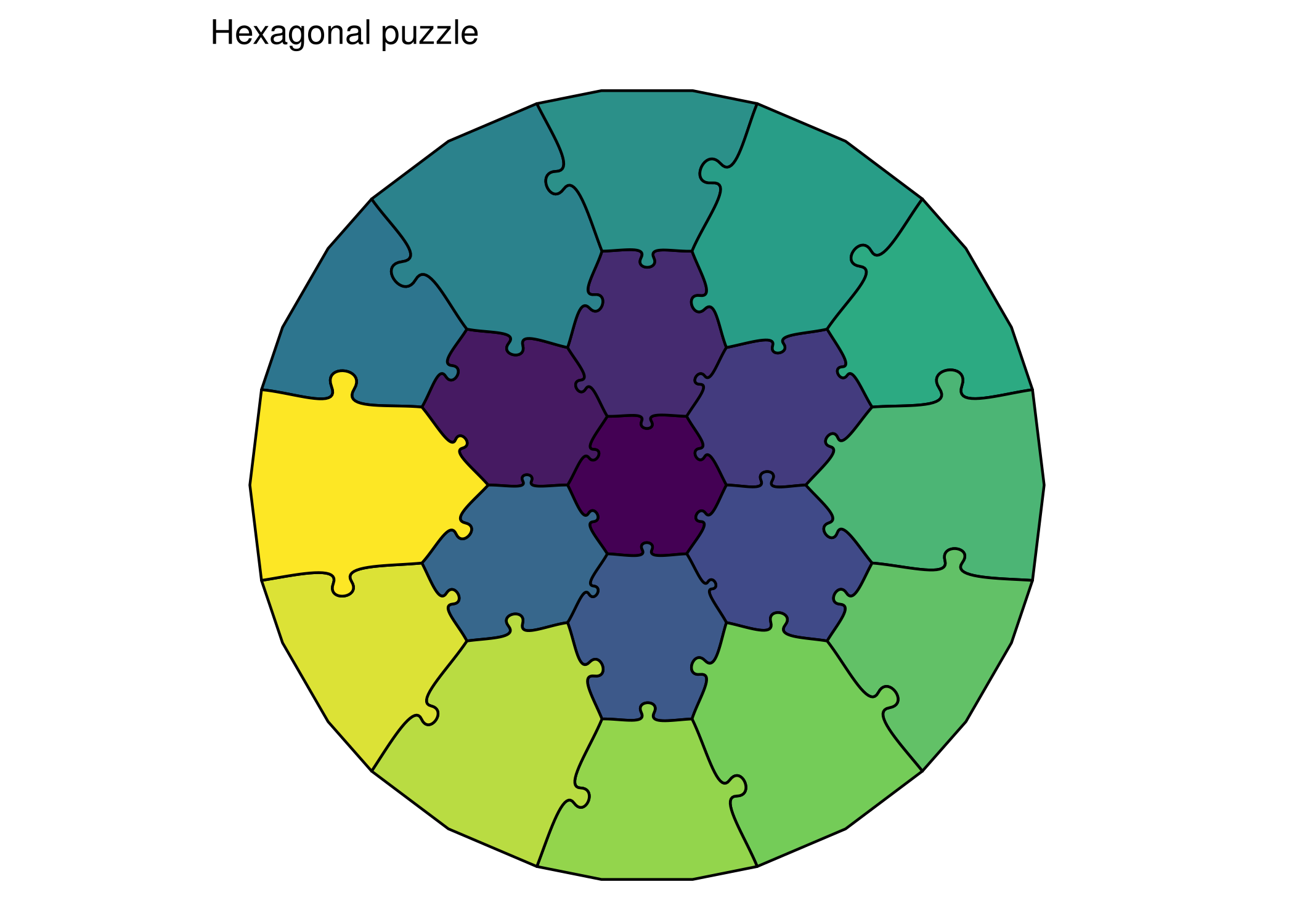
Or by writing the SVG:
result <- generate_puzzle(
  type = "hexagonal",
  grid = c(3),
  size = c(200),
  seed = 42
)

# Save as SVG
writeLines(result$svg_content, "puzzle.svg")
See Also
- PILES Notation - Fusion group syntax
- ggpuzzle Extension - ggplot2 integration
- Gallery: Rectangular
- Gallery: Hexagonal
- Gallery: SNIC